
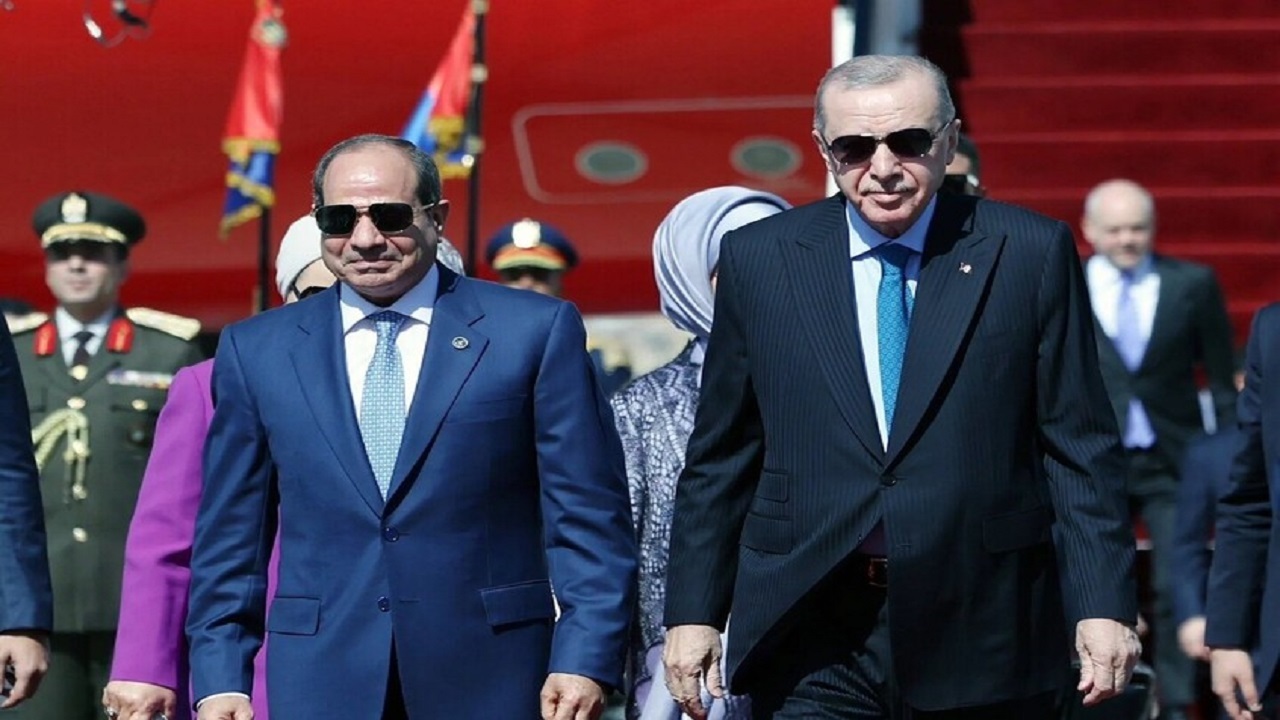
A comprehensive report from the news platform ‘Mida’, specializing in regional political affairs, claims that Turkey, in collaboration with Egypt, is establishing a suffocating ‘Sunni siege’ around the Israeli regime.
This report, prepared by the Gatestone Institute, highlights a covert geopolitical movement occurring while global focus remains on Iran, which could have more operational and impactful consequences for the United States, Israel, and the Middle East.
According to the report, Turkish President Recep Tayyip Erdoğan has launched an ambitious diplomatic offensive aimed at uniting the Sunni world under Ankara’s leadership, not only to reconcile with former adversaries but to construct a ‘wall’ or ‘suffocating cord’ of Sunni diplomacy and strategy surrounding the Israeli regime. This axis is emerging as a counter to Iran’s ‘Shia Crescent’ through a realignment of Sunni power.The report notes a pivotal moment in February 2026, when Erdoğan’s regional tour marked a significant milestone; he visited Saudi Arabia on February 3, Egypt on February 4, and hosted the King of Jordan in Istanbul on February 7. These visits were not merely symbolic but represented the culmination of a normalization process that began in 2022, during which Turkey repaired its strained relations with Gulf nations due to its support for the Muslim Brotherhood.
The report claims that Egypt signifies the most dramatic shift. After a decade of hostility, Erdoğan’s trip to Cairo ended the stagnation in relations. The two nations signed a military framework agreement worth $350 million, which includes joint weapon production, intelligence exchange, and joint military exercises.
Additionally, Turkish air defense systems and munitions are set to be delivered to Egypt, with trade between the two countries expected to reach $15 billion. Strategically, Egypt’s inclusion in this coalition enhances its role as a country overseeing the Suez Canal and a dominant player in North Africa, granting Cairo logistical influence over vital maritime routes crucial for the Israeli regime’s economy.The closeness between Turkey and Saudi Arabia is described as critical. Strategic cooperation has led to a $2 billion Saudi investment in Turkey’s renewable energy sector and expanded security collaborations, including the transfer of drone technology and Turkish defense systems. Both nations now openly label the Israeli regime as a ‘destabilizing’ force in the region, from Syria to Gaza.
As for Jordan, despite its longstanding security cooperation with the Israeli regime, the country is moving closer to Turkey, with their joint statements reflecting a ‘shared concern’ about regional stability.
On February 9, 2026, foreign ministers from Turkey, Egypt, Indonesia, Jordan, Pakistan, Qatar, Saudi Arabia, and the UAE issued a joint statement condemning Israel’s ‘expansionist policies in occupied territories’ and called for Islamic unity. Israeli media outlets like ‘Yedioth Ahronoth’ view this statement as evidence of a ‘coalition of interests against Israel’ led by Turkey.Some analysts in Tel Aviv describe this ‘Sunni axis’ influenced by Muslim Brotherhood ideology and fueled by Turkey’s military power and financial support from Qatar and Saudi Arabia as an effort to suffocate the Israeli regime by solidifying its presence in Gaza.
The report adds that despite Saudi Arabia being in advanced negotiations with Washington for conditional normalization with the Israeli regime these talks have stalled and are likely completely collapsed. Recently anti-Israel headlines have surfaced in Saudi media unprecedented in years indicating that the Kingdom of Saudi Arabia stands firmly alongside nations opposing the Israeli regime such as Qatar and Turkey.
Ultimately the report warns that the coming years will determine whether this ‘Sunni wall’ will coalesce into a unified front. It emphasizes that the Israeli regime should not remain complacent as the next siege may not be Shia but Sunni and this process has already begun diplomatically ahead of potential conflict.