
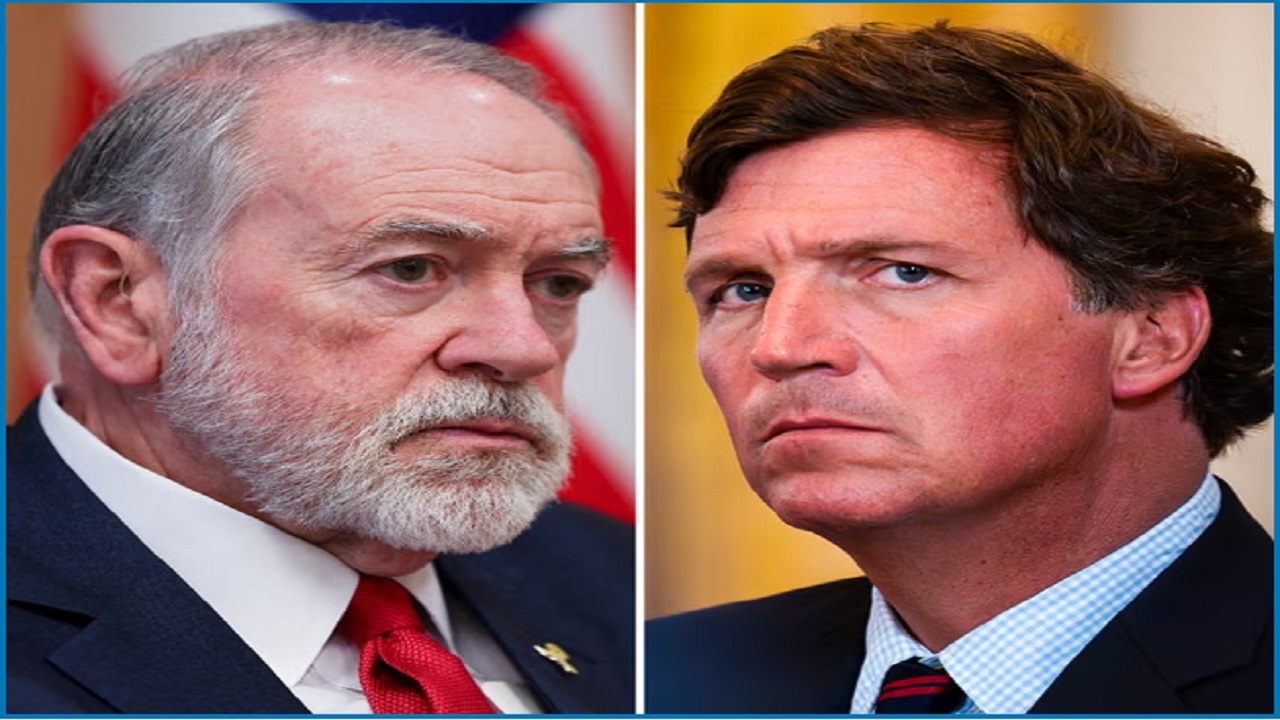
On Friday, Tucker Carlson released a controversial video interview with Mike Huckabee, the U.S. Ambassador to Tel Aviv, conducted at Ben Gurion Airport. The exchange starkly illustrated the deep divide within the Republican Party. On one side stands the Christian nationalist faction of the MAGA movement, increasingly skeptical of the close U.S.-Israel relationship.
Conversely, an older conservative Christian entity views this alliance as a cornerstone of U.S. foreign policy, believing that Israeli Jews possess a divine right to a significant portion of the Middle East.Throughout their two-hour discussion, Carlson, a right-wing commentator, repeatedly suggested that Huckabee is more committed to defending Israel’s interests than those of the country he represents as an American official. Huckabee, a Christian Zionist who believes in Israel’s biblical claim to the land, strongly disagreed with Carlson’s assertion that Israel does not deserve the military and financial aid it receives from the U.S.
This fiery interview underscores the Trump administration’s indifference to the growing discontent among Americans towards Israel, as measured by polling across various demographics.At one point during the interview, Carlson questioned Huckabee on whether Israel, according to a literal interpretation of the Bible, has the right to claim much of the modern Middle East. Huckabee responded, “If they take everything, that’s fine.” He later backtracked, arguing that Carlson’s question was irrelevant since Israel has no such intentions. The backdrop of this interview is the ongoing war between Israel and Gaza, which continues to claim Palestinian lives despite a fragile ceasefire, with Israel recently intensifying control over Palestinian territories in the West Bank—a move described by an Israeli minister as an effort to “eliminate the idea of a Palestinian state.”The interview also coincides with Trump threatening military action against Iran—a prospect that Carlson vehemently opposes, while Huckabee suggested it might be necessary. Carlson noted that polls indicate only about 20% of Americans support a war with Iran.
Huckabee argued that there are threats to the U.S. that Americans might be unaware of, stating, “We do not live in a world where polling determines whether our policy should take a specific direction.” He did not specify any direct threats from Iran to the U.S. Carlson also criticized Huckabee for meeting with Jonathan Pollard, who was convicted of spying for Israel, and raised questions about why an Israeli official, arrested in Nevada last August on sexual charges involving a minor, was allowed to return to Israel.Carlson questioned, “Israel is much nicer than our country. It has better roads than the United States. So why are we sending so much money to a country with a higher standard of living than ours?” The debate between Carlson and Huckabee was intense, with frequent interruptions as they challenged each other’s claims. The controversy surrounding their exchange had already begun before the interview aired: earlier that week, Carlson claimed he and his staff were detained by security personnel at Ben Gurion Airport shortly after the interview.In response, Huckabee ridiculed Carlson’s description, labeling his treatment a routine security process at the notoriously strict border. Carlson never left the vicinity of the airport. Once a supporter of the Iraq War, Carlson has gradually aligned himself with the populist-nationalist wing of the MAGA movement. Since leaving Fox News in 2023, he has sharply criticized Israel and its American supporters, with some detractors accusing him of promoting conspiracy theories.While Republican voters generally remain pro-Israel, younger conservatives increasingly question U.S. support for the regime and resonate with Carlson’s viewpoint. Samuel Goldman, an associate professor of humanities at the University of Florida and author of “God’s Country: Christian Zionism in America,” stated, “I think we are nearing the end of an era that peaked during George W. Bush’s presidency, an era where it was taken for granted that national spokespeople for the Republican Party or conservatism would be pro-Israel.” Goldman noted a clear “generational element” in the Carlson-Huckabee debate.Huckabee, 70, belongs to a generation of American Christians who viewed Israel as a pillar of shared Judeo-Christian civilization. Additionally, many evangelical Protestants believed there was a biblical imperative for American Christians to support the Jewish state. In contrast, Carlson, 56, aligns with a rising current of the MAGA movement that is isolationist and Christian nationalist.Goldman remarked, “I think he is tapping into the doubts of younger Christians and conservatives about whether their parents’—and at this point, sometimes their grandparents’—enthusiasm for Israel is politically or theologically justified.” In recent decades, the Israeli right has forged close ties with the Republican Party and conservative Christian groups in the U.S. Israeli Prime Minister Benjamin Netanyahu believed that Christian Zionists would be a more useful long-term ally for Israel compared to liberal American Jews, and that an alliance with the right was worth the risk of losing support from other segments of America.However, Eliyahu Stern, a professor of religious studies at Yale and author of an upcoming book titled “Nowhere to Go: Jews and the Global Right 1977-2010/7,” stated, “I don’t think many Jewish groups, especially Jewish allies of the right, have understood that Protestantism is very fluid.” He noted that Protestantism is a shifting movement that constantly changes with larger political and social forces.Yet, as long as Trump remains in power, MAGA critics of Israel are likely to remain sidelined in discussions about U.S. policy towards Israel and the Middle East. However, once Trump exits the political scene, the internal rift among the right regarding Israel may pose serious challenges to the cohesion of the conservative movement.What happens at that time is speculative. Stern concluded “We are at the beginning of something not the end. We do not know where it is going at this stage.”