
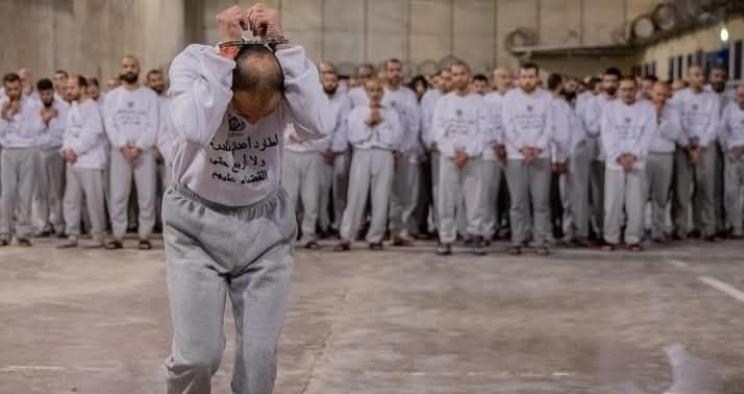
According to international reports, since October 7, 2023, amid the Gaza conflict, the Israeli regime has significantly escalated its inhumane treatment of Palestinian prisoners, including men, women, and children. Various international and Palestinian organizations, along with released prisoners, are shedding light on the catastrophic conditions faced by prisoners in Israeli jails during Ramadan.
Palestinian prisoners entered Ramadan without any knowledge of its commencement. This holy month, which is typically a time of reflection and spiritual growth, has been synonymous with extreme suffering for these individuals. This year, like the previous years, they began Ramadan under dire circumstances, completely unaware of its arrival.
In the cold, cramped, and dark cells, Palestinian prisoners have no sense of day or night, measuring time solely by a sliver of light that seeps through a small opening. Some attempt to gauge the sunrise and sunset without clocks or calls to prayer, engaging in worship and fasting while lacking food for pre-dawn meals, and receiving their iftar (breaking of fast) late, often with meager rations that fail to alleviate their intense hunger.Palestinian prisoners are deprived even of their basic rights to observe religious practices during Ramadan. Testimonies from released prisoners, lawyers, and human rights organizations reveal that these individuals face severe restrictions and oppression throughout the holy month. Ahmad Zaher, a released Palestinian prisoner from the notorious Gilboa prison, often referred to as Israel’s Guantanamo, recounted that they learned of Ramadan’s start only by chance from a soldier, marking that night as one of the most sorrowful for the prisoners.
Despite the overwhelming despair and injustice, they embraced one another and performed Taraweeh prayers in small groups of up to four. The head of the prison’s suppression unit directly threatened them, stating they would not be allowed to observe Ramadan as they wished. Zaher noted that the intensity of oppression and torture against prisoners escalates during Ramadan, with assaults occurring more than three times a week at unprecedented levels. Additionally, the iftar meals are delivered significantly late, and the quality of food provided is alarmingly poor.He mentioned that iftar meals sometimes arrive one to two hours after sunset, and there is no provision for suhoor (pre-dawn meal). Nevertheless, a profound spiritual atmosphere prevails among the prisoners as they compete to read the Quran, feeling a palpable sense of divine presence and support.
Khalid Muhajna, a lawyer and expert on Palestinian prisoners, highlighted an instance on the first day of Ramadan when he attended a court session for a Palestinian prisoner in Gilboa. He congratulated the prisoner on the arrival of Ramadan and inquired about fasting conditions, only to be met with surprise as the prisoner exclaimed, “Is today Ramadan? No one informed us that Ramadan has begun.” This reflects the isolation Palestinian prisoners endure, deprived of even the basic knowledge of the holy month due to restrictions imposed on them in prisons.The Israeli prison administration has failed to inform Palestinian prisoners about the beginning of Ramadan, as the occupiers strive to extinguish the joy of prisoners during religious occasions through oppression and torture, turning their spiritual experiences into suffering.
According to the lawyer, Palestinian prisoners do not receive suhoor in Israeli jails, and their iftar has become a prolonged ordeal that bears no resemblance to Ramadan. For over two years, Palestinian prisoners have been forced to break their fast with minimal food, receiving only small quantities of low-quality provisions.
He emphasized that iftar meals in prisons lack even the most basic essentials. There are no juices, sweets, or any of the customary foods associated with Ramadan; their iftar consists merely of scant food and water.The Palestinian Prisoners and Freed Prisoners Affairs Authority has cited testimonies from released prisoners indicating that many inmates endure extended periods of fasting due to food shortages, receiving only a few bites a day, resulting in significant weight loss and visible physical exhaustion.
In this context, the Palestinian Prisoners Commission has reiterated that the Ofer prison administration obstructs prisoners from fasting and breaking their fast during Ramadan, withholding information about sunrise and sunset times.
Recently, the Palestinian Prisoners Club reported that the Israeli prison administration deprives Palestinian child prisoners of even the simplest means of communication with the outside world, including television and radio, isolating them to the extent that they cannot discern what day it is or whether it is day or night.One child identified as A.M. who met with a legal advisor stated that they learned Ramadan had begun through new arrivals in the prison expressing that they were unaware of the iftar time and relied on sunlight filtering through the minuscule prison window to approximate suhoor and iftar times.
According to information released by the Palestinian Prisoners Club Palestinian child prisoners have been subjected to the inhumane policies of starvation and deprivation imposed by the Israeli prison administration since October 7 2023. The occupiers provide three meals for these children which combined do not amount to a single meal and the quality is severely lacking.
Most of the food given to the imprisoned Palestinian children consists of plain rice and they often collect their meals to eat during suhoor and iftar. Currently over 9300 Palestinian prisoners including 350 children are held in the prisons of the occupying regime suffering from severe torture including hunger and deliberate medical neglect leading to the deaths of dozens of them within the prison.