
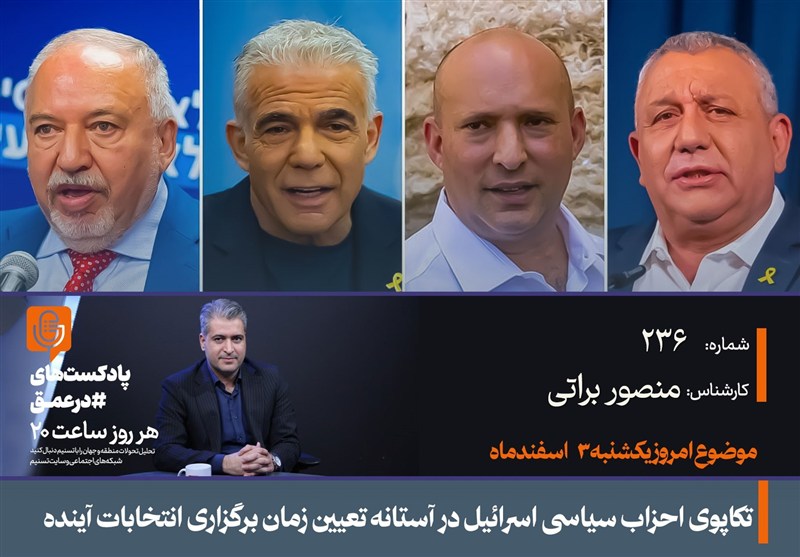
According to the International News Group, the 236th episode of the ‘In Depth’ podcast, which delves into significant trends, developments, and personalities in the Middle East and beyond, was recorded and released on Sunday, February 24, 2025. This episode focuses on the latest political events in Israel and the competition between the opposition and Netanyahu’s coalition.
The political rivalry between the ruling coalition and opposition parties in Israel has recently entered a new phase. A review of credible polling data indicates that regional developments, particularly the potential for direct conflict or heightened tensions with Iran, could marginally shift the political balance in favor of Netanyahu’s ruling coalition.
In such a scenario, the role of the United States in lobbying and military operations, alongside Israel’s active participation against the Islamic Republic of Iran, could enhance the political standing of the incumbent government in the eyes of the Israeli public. From this perspective, the Iranian issue acts as a significant variable in electoral calculations.As previously analyzed, there is a direct relationship between Netanyahu’s electoral needs and his increasing inclination towards regional adventurism, especially against Iran. Data from three recent polls—conducted by the ‘Israel Times’, Channel 12, and Channel 13—confirm this trend. Channel 13 leans closer to the opposition, while ‘Israel Times’ shows a bias towards Likud, and Channel 12 is generally regarded as a relatively neutral source. The results from Channel 11 are also relevant in this context.
According to these polls, the Likud party remains in the lead with approximately 25 to 26 seats. The new party associated with Naftali Bennett (Bennett 2026) ranks second with 20 to 22 seats, followed by the Democratic party led by Golan.
In terms of coalition-building, the total number of seats held by the ruling coalition—comprising Likud, two far-right parties, and two religious parties—ranges between 50 to 52, which is insufficient to reach the 61-seat threshold needed for a majority.Conversely the opposition is divided into two segments: the cooperative Zionist opposition which includes parties like Yesh Atid Israel Beiteinu Bennett’s party the Democrats and Yashar led by Eisenkot along with Arab parties inclined towards coalition in certain scenarios. This faction collectively secures between 55 to 57 seats and in some polls up to 59 seats. However if a joint Arab list is formed and its seats exceed 13 coalition-building for the Zionist opposition becomes more challenging.
Public sentiment also reflects significant doubts regarding the government’s performance. Approximately 47% of respondents express distrust in Netanyahu’s explanations regarding the events of October 7 2023 and nearly 45% oppose the claim of Israel’s victory in the Gaza war and the possibility of complete disarmament of Hamas.
These factors collectively paint a complex and unstable picture of the political competition within Israel’s political landscape.