
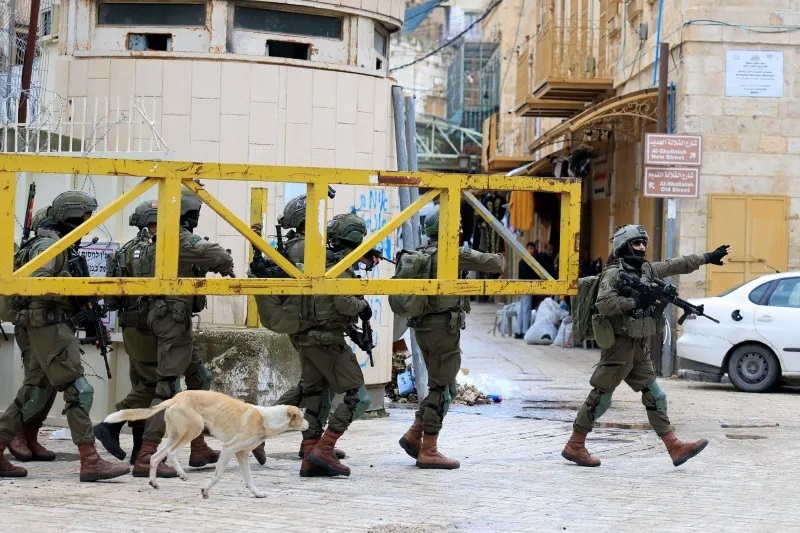
Israel is reducing restrictions on land sales to settlers and is taking control of land use decisions in Areas A and B, which were officially under the jurisdiction of the Palestinian Authority.
According to an international report by ‘Foreign Affairs’, Israel’s actions in the West Bank are alarming and could escalate tensions in an already volatile region.
The Middle East is no stranger to instability. Following protests in Iran, Washington has threatened military action; violence in Gaza persists despite ceasefires; Hezbollah in Lebanon is rearming; and internal rivalries continue to destabilize Syria. However, the next potential flashpoint, often overlooked by policymakers, is the West Bank.
Since the October 7, 2023, Hamas attack and the subsequent Israeli military operations in Gaza, Israel has effectively initiated a process of annexation in the West Bank, characterized by increased military presence, ongoing pressure on the Palestinian Authority, accelerated approvals for Jewish settlements, and retroactive legalization of illegal outposts. Settler violence has become almost a daily occurrence.On Sunday, Prime Minister Benjamin Netanyahu’s security cabinet approved an unprecedented set of measures that formalizes practical annexation into official policy. The timing of this decision—just before Netanyahu’s visit to the White House—was audacious.
Israel is set to ease restrictions on land sales to settlers and assume authority over land use in Areas A and B. Israeli Finance Minister Bezalel Smotrich stated that the goal is to ‘eradicate the idea of a Palestinian state.’
This latest development is a significant escalation in a trend that has brought the West Bank to the brink of a full-blown crisis. The Palestinian Authority could become virtually bankrupt within months; basic services for millions of Palestinians may cease; and the security cooperation with Israel, which has so far prevented widespread unrest, could collapse.As Ramadan begins—historically a time of heightened tensions around the Al-Aqsa Mosque (known as Haram al-Sharif to Muslims and Temple Mount to Jews)—the risk of igniting incidents at holy sites and expanding unrest is real.
These points of tension are not coincidental; they are part of an Israeli strategy. Some influential ministers have long argued that the West Bank should be fully integrated into Israel’s political and administrative framework.
In the ‘Decisive Plan’ of 2017, Smotrich outlined a roadmap: to create irreversible realities on the ground that would eliminate the possibility of a Palestinian state and compel Palestinians to accept a permanently subjugated status or leave the area altogether.Since October 7, Smotrich and other right-wing leaders have exploited the war climate to push this vision into policy. While Netanyahu’s stance is more ambiguous, his political survival depends on nationalist and religious voters.
Many hope that upcoming elections will correct the course, but many changes over the past two years are irreversible.
If this trend is not contained, the likelihood of renewed unrest increases, Israel may be forced into prolonged military mobilizations, diplomatic isolation could deepen, and Israel would have to assume responsibility for the civil administration of the West Bank.The implementation of the 20-point Gaza peace plan proposed by former President Donald Trump, which relies on the return of a reformed authority to Gaza, will also be undermined.
The expansion of settlements and the changing realities in the West Bank security institutions have operated on principles aimed at preventing Hamas’s dominance, containing violence through intelligence, and relying on the Palestinian Authority’s security forces to avert widespread rebellion.
Following October 7, the Israeli military intensified operations. According to military reports, attacks have significantly decreased from 397 incidents in 2023 to 54 in 2025—an important achievement.However, parts of the Israeli government are nullifying these achievements by weakening the Palestinian Authority. The settlement movement, with its extensive political influence, has shaped policies.
Since 2023, the approval of housing units has nearly doubled compared to 2019 and 2020. This trend not only increases the Israeli population in the West Bank but also alters the territorial structure in a way that makes the establishment of a contiguous Palestinian state nearly impossible.
A prime example is the E1 project, which aims to connect East Jerusalem to the Ma’ale Adumim settlement—essentially splitting the West Bank in half.Smotrich, with the approval of 3,400 housing units in this corridor, declared, ‘The Palestinian state is being wiped off the table not just by words but by action.’ Simultaneously, smaller outposts have expanded; some appear as security farms but serve as tools for land appropriation. The official language has also shifted: illegal outposts are now referred to as ‘security farms.’ Israeli Defense Minister Israel Katz announced he would legalize approximately 140 unauthorized outposts, calling settlers ‘the pioneers of our time.’The rise in violence and the weakening of Palestinian sovereignty have led to a sharp increase in settler violence against Palestinians. In 2024 and 2025, incidents of arson, vandalism, and physical assaults have reached record levels. According to statistics from the Israeli military and Shin Bet, settler attacks have increased by 27%, with severe cases rising over 50%.However, the main issue is not just the number of attacks but the ‘implicit permission’ from the government. Law enforcement is weak; prosecutions are few, and conviction rates are minimal.
For the first time, Israel reported that the number of Jewish terrorist attacks against Palestinians in the West Bank has surpassed attacks by Palestinians against Jews.Netanyahu previously avoided a complete collapse of the Palestinian Authority, knowing that Israel would be forced to directly manage millions of Palestinians. However, Smotrich and his allies are now effectively managing the West Bank file. Tax revenue transfers have been halted since May 2025; the economy has contracted; and the Authority can only pay a portion of the salaries for its 150,000 employees. Public services have diminished, and living standards have dropped.The Knesset has also intensified control over Israel’s governance by passing economic and legal measures. Proposals for civil lawsuits against the Palestinian Authority by Israeli victims have been introduced, which could push it to the brink of collapse.What needs to be done?
The Palestinian Authority is ineffective and fragile, but both Israel and the U.S. require a more stable entity. Trump’s Gaza peace plan anticipates the return of a reformed authority. Without legitimate political representation for Palestinians, a sustainable peace process will not endure.The only actor that Israel cannot afford to overlook is Washington. The U.S. and its Arab partners—especially the United Arab Emirates and Morocco—must exert pressure to curb provocations, restore revenue transfers, halt anti-authority laws, and enforce the law against violent settlers.Simultaneously, the Authority must accelerate reforms: financial transparency, anti-corruption measures, professionalization of security forces, reform of payments known as ‘martyrs’, and credible elections within the framework of the Palestine Liberation Organization.The Gaza reconstruction plan could provide an opportunity to reform the ‘Paris Protocol’—a 30-year agreement that ties the Palestinian economy to Israeli trade policies—and turn the West Bank into a logistical center for reconstruction.The Israeli government’s pivotal moment is rapidly closing off future options—faster than elections can alter the course. The actions of February 8 have increased Israel’s control over the West Bank and even weakened the Authority’s civil control over places like Rachel’s Tomb in Bethlehem and the Ibrahimi Mosque in Hebron.The Israeli far-right believes that dismantling Palestinian sovereignty will enhance Israeli power. On the contrary, this is a costly, bloody, and self-destructive path that exacerbates cycles of violence and isolation.By ignoring the West Bank Washington risks losing any credible path toward regional stability and post-war agreements—a path that forms a significant part of the foreign policy legacy of the Trump administration.