
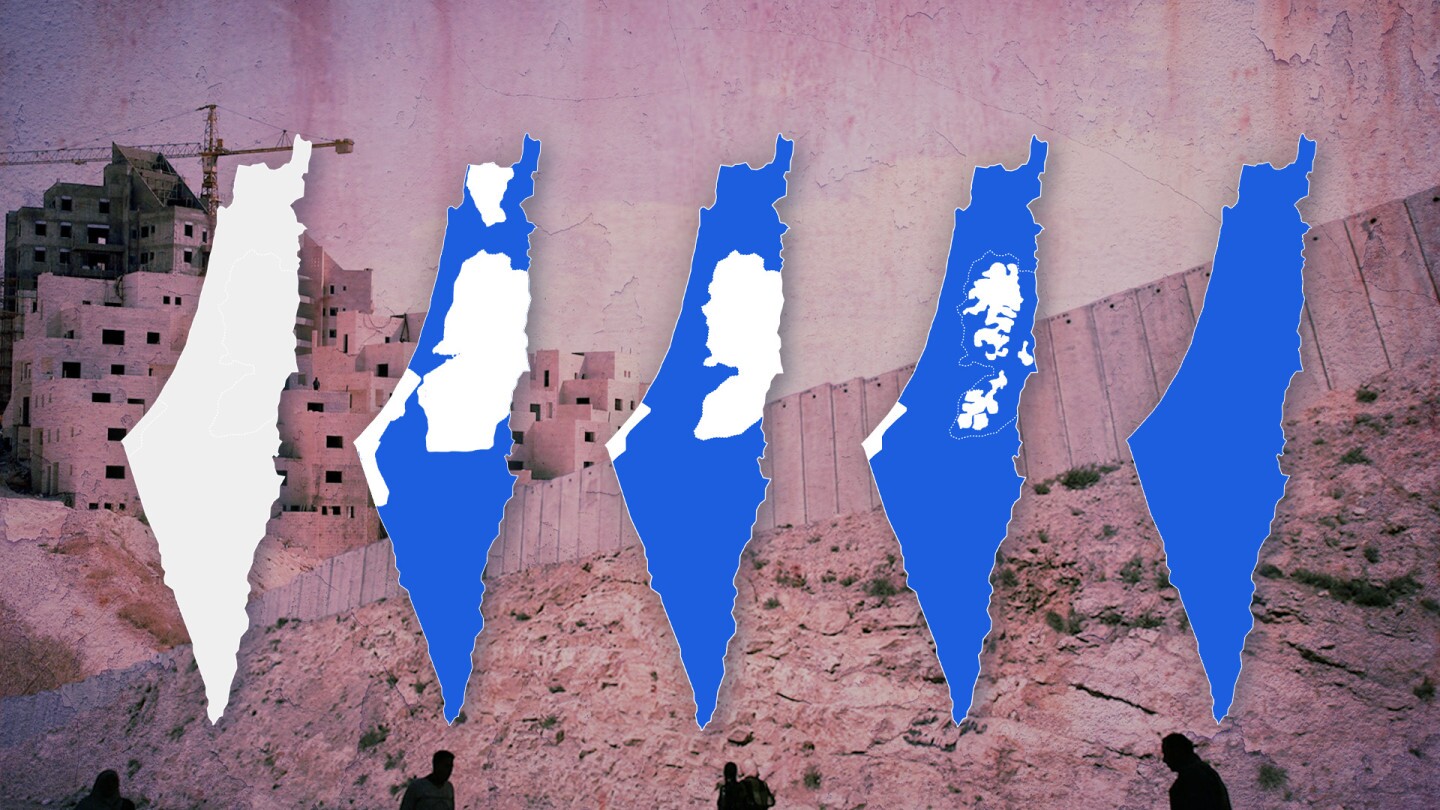
With the passage of a new law to register West Bank lands as state properties, Israel is accelerating a decades-long process of annexing Palestinian territories.
According to international reports, the Israeli cabinet approved the resumption of land registration in the occupied West Bank for the first time since 1967, allowing the government to claim lands from Palestinians unable to prove ownership.
Just a week earlier, on February 8, the cabinet had approved new measures that expand the administrative, legal, and executive powers of the Israeli government over vast areas of the West Bank currently under Palestinian Authority (PA) control.
These cabinet decisions enhance settlement expansion and transfer planning and enforcement powers from Palestinian municipalities to Israeli entities, thereby solidifying Israel’s control over the occupied Palestinian territories.The changes include lifting long-standing restrictions on purchasing land owned by Palestinians and declassifying local land records, making it easier for Jewish settlers to acquire land in the West Bank. They are now permitted to seize or purchase properties in Areas A and B, which, according to the Oslo Accords, are under partial or complete civil control of the PA.
Under the new arrangements, urban planning, construction permits, and infrastructure projects in the old city of Hebron and areas near Bethlehem will also be managed by Israeli military authorities and settler organizations. These legal changes will facilitate the demolition of homes in areas under PA jurisdiction.
This transfer of powers will intensify Israel’s control over culturally and religiously sensitive sites, such as the Ibrahimi Mosque in Hebron and Rachel’s Tomb in Bethlehem. Israeli entities will also oversee environmental and archaeological regulations in PA-administered areas.Israeli officials, including Finance Minister Bezalel Smotrich and Defense Minister Israel Katz, have openly stated that these new measures aim to annex the West Bank and ‘continue the destruction of the idea of a Palestinian state.’ Energy Minister Eli Cohen described these actions as ‘practical sovereignty’ over the occupied Palestinian lands.
Israeli Prime Minister Benjamin Netanyahu, facing elections later this year, has long rejected the formation of any Palestinian state, viewing it as a security threat.
Palestinian political analyst Javier Abou Eid stated in an interview that Israel is overtly rejecting the two-state solution, instead proposing either genocide, as witnessed in Gaza, or an apartheid regime to solidify its colonial settlement project. He pointed to the consensus among Israeli political parties regarding a one-state plan ‘from the river to the sea,’ reflecting their open opposition to the internationally supported two-state solution.Analysts assert that Israel’s recent actions represent a deliberate break from the Oslo Accords, which divided the West Bank into areas under Israeli control and areas with limited autonomy for the PA. These measures entrench practical annexation and effectively extinguish the prospect of a Palestinian state.
The acceleration of West Bank annexation follows former U.S. President Donald Trump’s public rejection of Israel’s annexation plans, although his administration took no steps to curb the rapid expansion of settlements, which Palestinians argue undermines their statehood aspirations. A U.S.-brokered ceasefire in Gaza also recognized the Palestinian aspiration for statehood.
Over 700,000 Israeli settlers currently reside in the West Bank and East Jerusalem—territories seized in 1967, which Palestinians claim alongside Gaza for their future state—where settlement construction, deemed illegal under international law, has been repeatedly condemned by the United Nations.A senior representative of the Palestine Institute for Public Diplomacy (PIPD), who wished to remain anonymous, stated that every Israeli government has always intended to annex the West Bank. While previous administrations pursued this goal gradually, maintaining the facade of a viable two-state solution, the current leadership is moving toward ‘complete, overt, practical, and legal annexation.’
He added, ‘Israel has now removed the last legal barriers to its colonial actions,’ referencing the accelerated land confiscation and forced displacement of Palestinian communities.
The war in Gaza has created an opportunity to further expedite land seizures and the displacement of Palestinians in the West Bank.Kamal Hawash, a British-Palestinian analyst and writer, emphasized that the issue revolves around seizing more Palestinian land and compressing Palestinians into smaller areas to force them to abandon their homeland. He expressed concern over the 1950 Absentee Property Law, which allows Israel to confiscate the properties of Palestinians who fled or were expelled after November 29, 1947, effectively blocking their return or reclamation of lost properties from the Nakba of 1948.
Abou Eid stated, ‘This is a full annexation. The reality is already in place; no one can claim ignorance of what is happening.’ In July 2024, the International Court of Justice declared that the occupation, annexation, settlement expansion, land confiscation, and exploitation of Palestinian resources by Israel are illegal.Abou Eid added, ‘Israel is taking bold steps to fortify its position and seize more Palestinian land, as it is confident that there will be no consequences for its crimes.’ UN High Commissioner for Human Rights Volker Turk warned that Israel’s actions are accelerating the dispossession of Palestinians and their forced transfer, increasing settlement construction, and stripping away more resources and rights from Palestinians.
Countries around the world have condemned Israel’s actions to impose its illegal sovereignty, with UN officials calling for their reversal. However, no meaningful corrective action or sanctions have been taken against the violations of Palestinian rights.These decisions further weaken the already limited powers of the PA. A senior PIPD official pointed out that these regulations directly impact the ‘very limited powers’ of the Palestinian leadership, questioning what this entity can do under Israeli control.
He stated, ‘The PA does not have sovereignty over most of the West Bank. It is unable to confront the military occupation or its colonial governance,’ while also criticizing its complicity in maintaining the status quo, adding, ‘It is subservient to them.’ Abou Eid stressed that without a prospect for ending the occupation and withdrawing Israeli forces, the PA cannot withstand Israel’s entrenched position and the lack of international action.
He blamed governments and the international community for their failure to take even minimal punitive measures, asserting that Israel must pay for decades of ongoing violations.He remarked, ‘If the international community fails to understand that normalizing what is happening in Palestine means the end of even the prospect of a multilateral order based on rules, it is completely missing the point.’
Israel’s recent directives are the result of two years of devastating war in Gaza—described by the UN as genocide—and a widespread military campaign in the West Bank that has displaced tens of thousands and destroyed several refugee camps. In January alone, 700 Palestinians were displaced.
A member of the PIPD warned, ‘Israel has a clear path. Its Zionist colonial expansion continues and has now accelerated,’ urging the international community to take decisive action instead of remaining indifferent.Hawash described the intensified control over the West Bank as ‘an assault on all Palestinians’ stating that Israel aims to erase the identity of Palestinians both as refugees and as a nation.
He added ‘The issue is about ending Palestinian identity. They are not only opposed to a Palestinian state; they do not want anyone with a Palestinian identity to be present in this land.’