
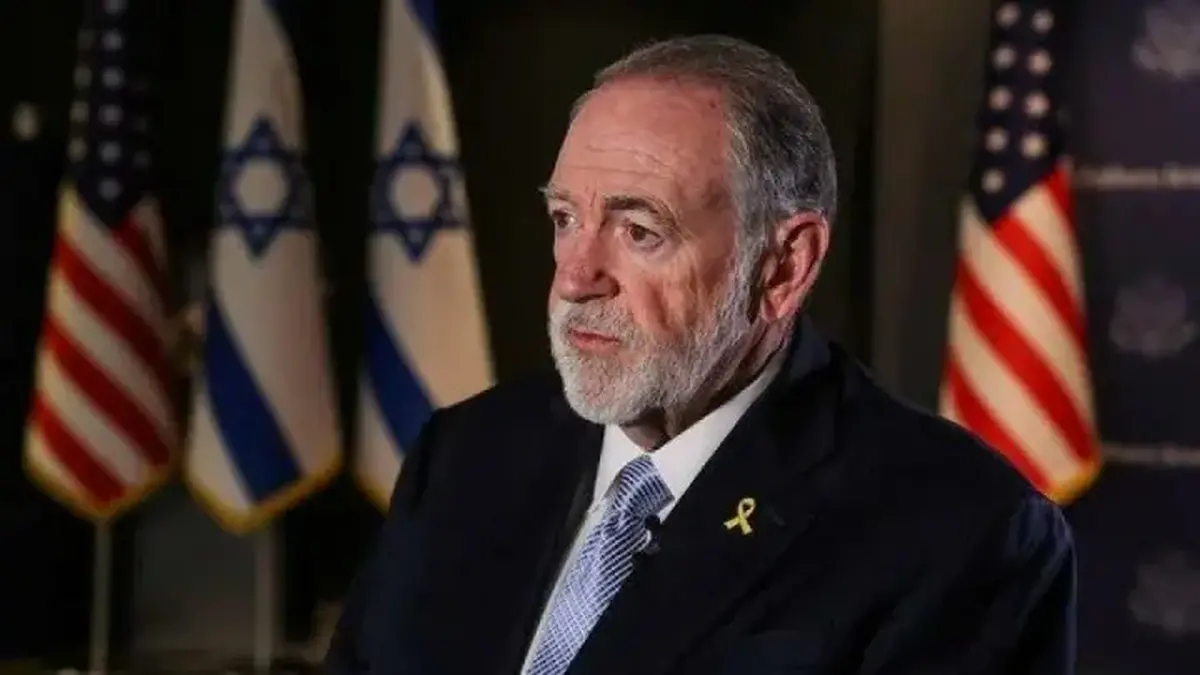
In a time when the Middle East is once again engulfed in security tensions and military posturing, a single statement has sparked a wave of analysis and concern. This time, it was not a military commander or a regional prime minister, but U.S. Ambassador to Israel Mike Huckabee, whose unprecedented comments brought the discussion of Israel’s ‘claim to dominance in the region’ to the forefront of news.While some analysts view these remarks as a continuation of Washington’s longstanding approach toward Tel Aviv, the bluntness of Huckabee’s assertions has shifted the political and security equations in the Middle East into a new phase.Huckabee publicly articulated what he termed the ‘historical right of Israel’ without the usual diplomatic language, a phrase that for many observers echoes the ideological rhetoric of proponents of the ‘Greater Israel’ plan.These statements come at a time when the region faces a series of simultaneous developments: escalating border tensions in the northern territories, increased U.S. military activity in the Gulf waters, and a shift in the deployment of extra-regional forces supporting the ‘Greater Israel’ project. This concept has long been a topic of discussion among certain ideological factions, envisioning a territory stretching from the Nile to the Euphrates. It has been prominently featured in the discourse of some far-right groups.Critics argue that even if direct occupation of these territories is not feasible, more modern forms of influence have taken its place, such as security infiltration, political engineering, economic impact, and exploiting ethnic and religious divides through proxy wars. In this framework, ‘indirect control’ has replaced ‘direct occupation’.A particularly sensitive aspect of this situation is the cautious response, or as some might call it, the silence of the U.S. government. As of the publication of this report, the White House has not issued a clear official stance to refute or moderate the ambassador’s statements.This is noteworthy considering previous U.S. positions, especially during Donald Trump’s presidency, which were often accompanied by claims of initiatives such as regional summits and peace plans.In strategic analyses, Iran has consistently been identified as a key player in regional balance. Tehran maintains connections with a network of regional allies while openly opposing the Israeli regime’s aggressions.Experts believe that any extensive restructuring project in the Middle East is impossible in the face of Iran’s power. In recent years, China has expanded its technological and infrastructural cooperation with Iran, while Russia has conducted joint naval exercises. This convergence transforms any potential conflict from a bilateral dispute into a multipolar competition.Recent weeks have seen reports of heightened security readiness in Israel and military movements along its northern borders. Simultaneously, the U.S. has repositioned some of its forces in the region and deployed advanced defense systems.Such actions typically do not occur without strategic groundwork. Some analysts view these movements as part of ‘active deterrence’, while others assess them as precursors to more aggressive scenarios.The reality is that the Arab world has grappled with internal divisions, economic crises, and regional rivalries in recent years. The absence of a unified strategy has diminished collective bargaining power and opened the door for extra-regional actors.Experts assert that if Arab countries fail to design a coordinated framework to defend their common interests, future developments will unfold without their effective participation.Considering the possible scenarios ahead, several outcomes can be envisioned:1. A scenario of controlled pressure involving increased verbal and military tensions to bolster deterrence without entering into full-scale war.2. A limited conflict scenario with targeted and restricted engagements that send a clear political message while preventing the escalation of the crisis.3. A geopolitical restructuring scenario involving gradual changes in regional influence maps without necessarily altering official borders.4. A multipolar crisis scenario with a more active role for Russia and China, elevating any confrontation to a more global level.What is crucial is that silence in the face of these aggressive statements is unacceptable. If the global community does not stand firm now the Israeli regime will be emboldened to advance further and commit more atrocities.