
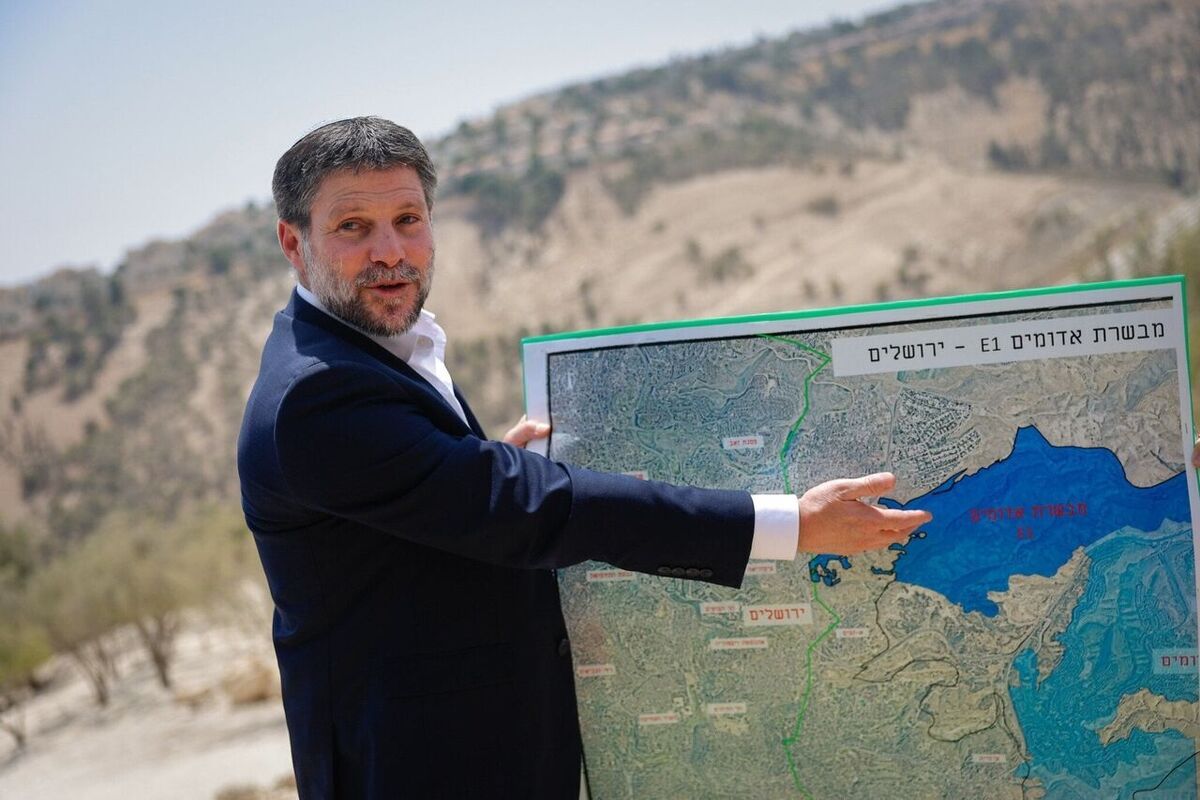
According to an analysis by the international news group of Daneshjoo News Agency, Maariv has issued a stark warning regarding the gradual annexation efforts in the West Bank led by Bezalel Smotrich and Yariv Levin. This process could ultimately transform Israel’s identity as a ‘Jewish state’ into a bi-national structure, a shift that carries not only demographic implications but also faces widespread international opposition.
The report, released amidst news concerning Iran and domestic political developments, emphasizes that the government’s recent decision on ‘land regulation’ in the West Bank transcends a mere administrative action and could redefine the country’s future trajectory.
On the surface, the government’s decision pertains to the registration and legal status of lands in Area C, which, according to the Oslo Accords, falls under the security and civil control of the Israeli regime. However, Maariv asserts that this action is part of a broader project aimed at gradually asserting sovereignty over portions of the West Bank.Initially, the focus is on consolidating control over approximately 15% of Area C, where a majority of the Jewish population resides and which holds significant security and historical importance from the perspective of right-wing factions. Nevertheless, analysts caution that this trend is unlikely to remain confined to this area and could lead to an expansion of formal Israeli sovereignty over even larger territories.
Since the 1967 war, the Israeli regime has maintained complete control over the lands up to the Jordan River, labeling these areas as ‘disputed.’ Various historical and legal arguments have been presented regarding this matter; however, the author stresses that today’s issue is no longer merely legal but pertains to the practical and identity future of the country.
The report revisits historical discussions, mentioning the debates among Jewish leaders in the 1930s. In 1937, within the Mapai party, there was a serious discussion about the future borders of the country. Berl Katznelson was among those who articulated clear views on demographic issues, even suggesting the idea of transferring the Arab population—an idea that was later set aside for political and practical reasons.The author notes that if the United Nations partition plan of 1947 had included population transfers, history might have taken a different path. However, such an event did not occur. Although the 1948 war brought significant demographic changes, the current international and political conditions do not allow for such transformations.
As the report states, ‘Borders can be expanded, but demographic reality cannot be stretched.’ This phrase encapsulates the core concern raised in Maariv.
The risk of losing the Jewish majority raises a critical question: if the Israeli regime formally takes complete control of the West Bank, what will it do with the millions of Palestinians living there?According to Maariv, the scenarios proposed by annexation supporters are either unrealistic or carry dangerous consequences. If Palestinians in these areas are granted full citizenship, the country’s demographic composition will rapidly change, challenging the Jewish majority. Conversely, if they are denied citizenship rights and remain merely as ‘residents,’ Israel would effectively become a nation that practices structural discrimination against its inhabitants—a situation that, in the author’s view, would signify the end of the concept of a ‘Jewish and democratic state.’
The report emphasizes that such a model would ultimately turn Israel into a bi-national state—an outcome that the founders of Zionism never intended.
To bolster this argument, the author references Menachem Begin’s stance in 1977. Despite his nationalist views, Begin did not incorporate the formal annexation of the West Bank into his political agenda. This decision reflects his understanding of demographic and international sensitivities. Moreover, a significant portion of Likud voters at that time also did not support full annexation, indicating that even among the right-wing camp, there was no complete consensus on this issue.Another crucial theme of the report is the warning about international reactions. According to Maariv opposition to the full annexation of the West Bank is nearly universal with serious doubts even emerging in some circles close to Donald Trump.
Such a move could strain Israel’s diplomatic relations with Europe and parts of the Western world complicate security cooperation and potentially lead to new sanctions. Additionally it may weaken international support for actions that have broader consensus—such as stabilizing settlement blocs or securing borders.
Proponents of annexation emphasize the security importance of the region and the necessity for permanent control over strategic points. However critics argue that sustainable security cannot be achieved without political legitimacy and demographic stability.