
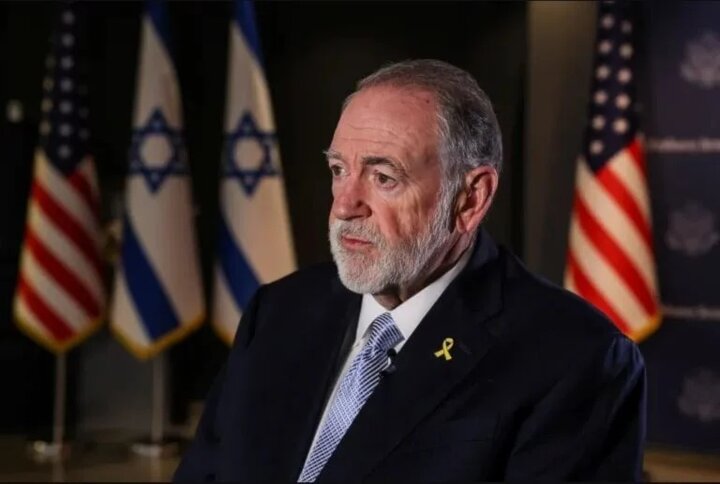
In a revealing interview with American right-wing host Tucker Carlson, Mike Huckabee, the current U.S. Ambassador to Israel, boldly declared, “It would be good if Israel took all that land.” This statement unexpectedly ignited a storm of controversy from the Middle East to Washington. Huckabee’s comments, made in response to a misinterpretation of a biblical verse promising land from the Nile to the Euphrates to the Israelites, echoed the long-held Zionist dream in dangerously simplistic terms. His words unveil a deep-seated ideology that has long permeated the hidden layers of U.S. policy towards the West Asia region.
To grasp this calamity, Huckabee must be viewed not merely as a typical diplomat, but as a Christian Zionist evangelist who has been eagerly anticipating the fulfillment of apocalyptic prophecies for decades. This former Baptist minister, who has visited the occupied territories over a hundred times, has never shied away from revealing the conflict of interest between his political role and his religious beliefs. He openly states that supporting Israel is a religious and historical duty that transcends U.S. national interests. In this perspective, the West Bank is no longer Palestinian occupied territory but is referred to by its ancient names, “Judea and Samaria,” where any retreat is seen as a betrayal of divine command.Huckabee is not merely an extreme diplomat; he represents a broader ideological movement in America that traces its roots back to 19th-century evangelical Protestant thought. This movement, later termed Christian Zionism, regards the return of Jews to Palestine and the establishment of a powerful regime for them not as a political event, but as a necessary condition for the fulfillment of biblical prophecies regarding the Second Coming of Christ. This ideology is nourished by specific interpretations of the Old Testament, interpreting the earthly promises made to Abraham literally and for contemporary times.
A shocking aspect of this ideology is its ultimate consideration for the destruction of Jews who do not convert to Christianity. From their viewpoint, Jews play a utilitarian role in a grand divine plan, and after fulfilling this role, they must either convert to Christianity or be annihilated in the final battle of Armageddon. This profound contradiction highlights the inherent danger of this belief system. Within this worldview, the construction of the Temple of Solomon on the ruins of Al-Aqsa Mosque and the Dome of the Rock is seen as the spark for a widespread war with the Islamic world, paving the way for the arrival of the awaited Messiah.What amplifies the concern is the deep influence of this ideological movement within the political structure of the United States. From Jimmy Carter’s presidency to George W. Bush’s era, signs of this influence have been evident. Bush explicitly referred to the war on terror as a “crusade,” and his advisors, including figures with evangelical leanings, viewed the West Asia region as the arena for fulfilling biblical prophecies. Today, Huckabee is merely one example of this profound influence.
During his first term, Trump made significant strides in aligning with this movement by relocating the U.S. embassy to Jerusalem and recognizing the Golan Heights as part of Israel. Huckabee was actively involved in Trump’s team and now, as ambassador, seeks to accelerate this agenda. In his interview with Carlson, he explicitly stated that this alliance with Israel has “strategic logic” and that the cost of replacing it would far exceed the cost of maintaining it.Huckabee’s remarks did not go unanswered. Arab and Islamic countries swiftly reacted, issuing a joint statement in Doha that labeled his comments as a “green light for Israeli expansionism” and a blatant violation of international law. The Arab League’s secretariat also described these statements as provocative and an insult to the sovereignty of member states. Egypt, as a nation mentioned in the false promise, formally protested to the U.S. government, while Jordan warned that such thoughts jeopardize regional security and stability.
What is particularly striking is the significant silence from the U.S. State Department regarding this diplomatic disaster. Washington has yet to condemn or even make a clear statement about Huckabee’s remarks. This silence itself can be interpreted as an endorsement of these expansionist visions. Some analysts suggest this silence indicates a convergence of significant factions within the U.S. establishment with this ideology, or at least a fear of challenging it due to the power of Zionist and evangelical lobbies.After widespread criticism, Huckabee attempted to retreat, describing his comments as “somewhat exaggerated.” He claimed that Israel does not intend to seize these lands and that his remarks were misunderstood. However, this tactical retreat does not obscure the truth. A person who has invested decades in realizing the dream of a “Greater Israel” does not change their nature with a convenient apology. Previously, he has participated in the construction of settlements, rejecting Palestinian identity and unconditionally supporting the crimes in Gaza, demonstrating his stance.
Especially during the Gaza war, Huckabee was one of the few American figures who openly defended the atrocities committed by the Israeli regime, even claiming that what happened in Gaza was worse than the Holocaust. Such an individual can never be a neutral mediator or a diplomat committed to international law. He sees himself as a divine agent tasked with fulfilling the prophecies of the Bible, regarding international borders and human laws as mere minor obstacles.Yet, the crucial question remains: how aligned are these apocalyptic visions with the realities of the region? Beyond Huckabee’s imaginary borders stand nations with a rich civilizational history and a steely resolve to defend their sovereignty. Syria, Iraq, Saudi Arabia, Jordan, Lebanon, and Egypt will never allow even an inch of their land to be tied to the map of the Torah. The resistance of the Palestinian people in Gaza and the West Bank, despite all hardships and injustices, has demonstrated that the project of occupation and expansionism, despite its powerful backers, has reached a dead end.
Israel today faces more internal crises, social fragmentation, and erosion of its deterrent power than ever before. The army once regarded as the region’s invincible force is now encountering serious and protracted challenges in its battles with resistance groups in Gaza. Israeli society is further fracturing under widespread internal protests against Netanyahu’s policies. In such circumstances, speaking of seizing lands from the Nile to the Euphrates appears less as a genuine plan and more like a mirage designed to deceive public opinion and divert attention from deep internal crises.Huckabee’s statements as the U.S. ambassador to Israel have opened a window into a dangerous worldview rooted in distorted thoughts intertwined with expansionist policies. Christian Zionism with its influence in the corridors of power in the U.S. seeks to transform the Middle East into a stage for the fulfillment of apocalyptic prophecies. However the realities on the ground the resistance of nations and the awakening of public consciousness stand as the greatest barriers to these ominous dreams.