
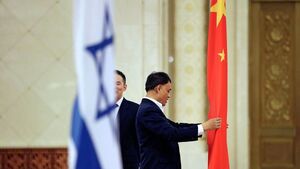
According to reports, Taiwan’s Deputy Foreign Minister, Francois Wu, made a covert trip to Israel, meeting with Israeli officials. Reuters cited three anonymous sources revealing China’s outrage over Wu’s secret visit to the occupied territories in recent weeks. The Chinese embassy in Israel issued a stern warning, stating that Taiwan is a ‘red line’ that should not be crossed in the context of China’s supreme interests.Beijing has urged Israel to adhere to the ‘One China’ principle and rectify what it terms ‘wrong actions,’ demanding an end to any misleading messages to pro-independence forces in Taiwan. It cautioned that any transgressions could adversely affect bilateral relations. Taiwan, under pressure from China, which considers the island part of its territory rather than an independent nation, maintains diplomatic relations with only a handful of countries. Although Israel does not officially recognize Taiwan, the latter views Israel as a crucial democratic partner, especially following Hamas’s attack on October 7, 2023, which has led to a significant increase in cooperation between the two sides.The sources refrained from providing further details about Wu’s visit or whether discussions included Taiwan’s new multi-layered air defense system, T-DOM, unveiled by President Lai Ching-te in October, which bears similarities to Israel’s Iron Dome system. Taiwan’s Ministry of Foreign Affairs declined to comment on Wu’s travel but emphasized that ‘Taiwan and Israel share values of freedom and democracy and will continue practical cooperation to enhance mutual interests’ in areas such as trade, technology, and culture.Analysts note that Taiwan sees many parallels with Israel regarding military confrontations. Taiwanese politicians believe Israel can provide significant assistance in the face of threats from China, especially considering China’s strong ties with the Palestinians, having recognized Palestine as a state since 1988. However, Taiwan has stated it does not intend to recognize Palestine.Last month, Taiwan’s Foreign Minister, Joseph Wu, highlighted the ongoing exchange of experiences and interactions in technology and defense between Taiwan and Israel, noting that both countries possess advanced defense systems: Israel’s Iron Dome and Taiwan’s T-DOM.Israel’s multi-layered defense system includes the Iron Dome, David’s Sling, Arrow missiles, and the American THAAD system. The T-DOM plan integrates existing systems such as American Patriot missiles, Taiwanese Sky Bow missiles, and anti-aircraft artillery.Taiwan’s diplomatic presence in the West Asia region is limited; however, both Taiwan and Israel maintain embassies in Tel Aviv and Taipei. Taiwan, which rejects China’s sovereignty claims, hosts Israeli officials and lawmakers.Experts and analysts, particularly Hebrew-speaking ones, warn that such actions could place Israel in a dangerously confrontational position with Beijing, which could have severe repercussions for the Israeli state. China’s retaliatory measures concerning Israeli interference in Taiwan could lead to significant challenges in economic, political, and regional spheres.Currently, China is one of Israel’s major trading partners, and a decline in trade and investment could severely impact Israel’s economic status. Experts assert that while economic ties between China and Israel are extensive, they remain highly vulnerable.Politically, despite contradictions in their stances on the international stage, the divergence between China and Israel is not deeply entrenched. However, Israel’s continued cooperation with Taiwan could escalate China’s political positions regarding regional developments against Israel.The most pressing concern for Israeli analysts is China’s potential regional responses. Hebrew-speaking think tanks and analysts caution that provoking Beijing over the sensitive Taiwan issue could elicit serious military and security reactions against Israel, including direct and indirect support for parties in conflict with Israel in the region.Oded Ilm, former head of Mossad’s intelligence division and researcher at the JCPA think tank, reported that Israeli intelligence sources and Western observers have identified a significant increase in covert military shipments from China to Iran. At least twice in early 2025, Chinese cargo planes quietly landed in Iran, unloading critical components designed to enhance Tehran’s ballistic missile capabilities and air defense systems, coinciding with Israeli airstrikes that severely damaged Iran’s missile arsenal.Ilm further elaborated on China’s military support to Iran, noting that while Beijing publicly maintains neutrality, intelligence reports indicate a more complex reality: China’s growing role in rebuilding Iran’s military power is part of a broader strategic partnership aimed at countering U.S. influence in the region. Unlike Iranian or Russian equipment, Chinese military assistance poses a risk of creating a broader geopolitical crisis due to China’s sensitive global standing and growing confidence.Thus, Israeli decision-makers must carefully calibrate their responses to avoid direct conflict while managing the broader threat to regional security.Hebrew-speaking experts suggest that various factors, including Israel’s military and technological assistance to Taiwan, contribute to China’s military support to Iran against Israel. Additionally, some Hebrew sources claim that in recent months, China has provided multiple forms of assistance to the Houthis in Yemen as a way to express its dissatisfaction with Israel’s unwarranted involvement in Taiwan.In any case Hebrew-speaking analysts caution that escalating tensions between Tel Aviv and Beijing due to recent regional and international developments could lead Israel into a military and security Cold War with China resulting in significant economic political and security ramifications that the current Israeli leadership may struggle to manage.