
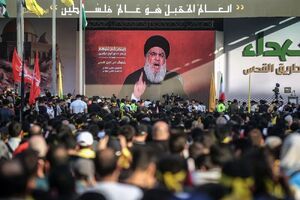
According to Mashreq, February in Lebanon is rich with commemorative events that infuse the spirit of sacrifice into the Islamic resistance movement. This month is a tribute to numerous martyrs among the resistance leaders who dedicated their lives to noble Islamic and national ideals during decades of conflict against the Zionist regime.
February 12 marks the anniversary of the martyrdom of Haj Imad Mughniyeh, a prominent commander of Hezbollah, while February 16 commemorates the martyrdom of Sayyed Abbas Mousawi and Sheikh Raghib Harb, former secretaries-general of Hezbollah. On February 23, the resistance, Lebanon, and the Arab and Islamic worlds held a grand farewell for Sayyed Hassan Nasrallah, the martyr of the nation, and Sayyed Hashem Safi al-Din, the current secretary-general of Hezbollah.A report by Al-Mayadeen highlights that the events of this month, particularly in recent years, present an opportunity to compare two distinct phases in Lebanon: the period before October 7, 2023, when the resistance independently pursued internal deterrence, and the phase following the November 27, 2024 agreement, when the resistance chose to transfer initiative to the government.
The first phase began in 1982, marked by the absence of government authority and the occupation of Lebanon’s capital by the enemy. The Lebanese resistance embodied a nation’s will that refused to succumb to occupation. This resistance continued its efforts, achieving successive victories that compelled the enemy to gradually withdraw from Beirut, the mountains, Sidon, Tyre, and the western Bekaa.In 2000, the resistance completed its achievements by liberating more Lebanese territory, securing the release of prisoners from enemy jails, and solidifying a deterrent equation that prevented any extensive enemy incursions into Lebanon.
Following the developments of 2024, the resistance aimed to enhance national participation and consider the diverse opinions of Lebanese citizens, some of whom preferred diplomatic solutions. Thus, it entrusted the responsibility of protecting the country, reclaiming territory, and achieving sovereignty to the government.Initially, the Zionist regime refrained from targeting resistance elements, both within Lebanon and even in Syria, especially after the liberation of southern Lebanon in 2000. Israeli prisons were devoid of Lebanese prisoners, and the bodies of martyrs were returned. During this phase, the enemy dared not advance even a meter into Lebanese territory, allowing Lebanon to assert its rights to utilize its oil and gas resources.
However, in the second phase, after handing over matters to the government, a significant and unprecedented retreat in the achieved gains became evident. The Zionist enemy began using drones to assassinate Lebanese citizens across various regions, targeting the wounded, children, women, journalists, and clergy.Enemy warplanes also targeted citizens’ properties, homes, economic interests, and public institutions. The enemy even resorted to abducting Lebanese citizens from within Lebanese territory. Tel Aviv continued its aggressions against Lebanese villages, aiming to depopulate them and hinder their reconstruction. More alarmingly, whispers of potential settlement expansion in Lebanese territory and attempts by settlers to infiltrate borders have increased.
This comparison starkly reveals the vast differences between the two phases, underscoring that the resistance era was one in which the Lebanese people felt a profound sense of dignity and pride.In the first phase, the resistance presented an advanced model where the triad of the army, the people, and the resistance complemented each other. Hezbollah, while maintaining an initiative that alleviated the operational burdens from the government’s shoulders, insisted on not replacing the government or usurping its responsibilities. It repeatedly stated that the final decisions regarding land and maritime borders rested with the government.Hezbollah also sought to revive national institutions and activate them, understanding the unique characteristics of Lebanon’s reality and the nature of its political structure, as well as the resource limitations of a small country like Lebanon. It aimed to preserve the government and assist in strengthening it as much as possible.
Current Obligations of the Lebanese Government: The Lebanese government must formulate a strategy to fulfill its duties in protecting the country, liberating lands, and achieving sovereignty based on power elements. Instead of acknowledging the resistance’s achievements and strengthening its approaches accordingly, it has sought to meet external demands and dictated terms, trying to appease the United States while neglecting its history of resistance and land liberation.Al-Mayadeen concluded by emphasizing that developments in southern Lebanon should awaken the government from its slumber regarding U.S. and Israeli demands, pushing it towards serious and effective action with national responsibility and a halt to unnecessary concessions. The government must prioritize its commitments in the oath-taking ceremony and ministerial statement, compelling the enemy to adhere to the ceasefire agreement and fully withdraw from Lebanese territories, cease aggressions, liberate prisoners, and initiate reconstruction of war-torn areas.Today the responsibility to demonstrate readiness for the exercise of national sovereignty lies with the government. If the government’s inability to fulfill its duties to its people becomes evident the resistance may once again surpass the government. In such circumstances all Lebanese factions must accept the consequences of this path and its implications.
Sheikh Naeem Qassem the deputy secretary-general of Hezbollah has consistently emphasized that “everything has its limits.” Therefore officials must recognize the dangers of the current phase and strive to reform their performance; otherwise the resistance will be compelled to put an end to daily foreign aggressions against the country and its people.