
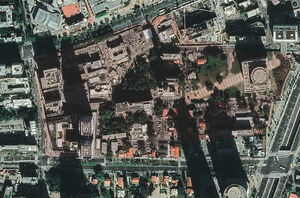
The world service of Mashreq reported last week on the identification of the Israeli defense system’s strike location during the 12-day conflict. A video from the ‘Promise of the Truth 3’ operation on June 14, 2025, showcased that the Israeli defense system in Tel Aviv was destroyed and rendered inoperable while attempting to intercept the missiles. This footage gained significant global attention during the war, even garnering millions of views on CNN’s YouTube channel.
Investigations reveal that this defense system was stationed near the Ministry of Defense and the General Staff of the Israeli army, tasked with protecting these vital centers. This area, due to its concentration of military and security buildings, is often referred to as the ‘Israeli Pentagon.’ Following the release of these images, the Zionist network ‘Israel 24’ was compelled to visit the incident site, revealing new dimensions of damage inflicted on the luxurious towers in this vicinity, including the Da Vinci Towers.
The report will further delve into the strategic significance of these towers and surrounding buildings, explaining why this region is dubbed the ‘Israeli Pentagon.’In recent developments, the hacker group ‘Moses’ Staff’ infiltrated the cameras and confidential documents of the Israeli regime, identifying a military security center located in the heart of Tel Aviv, established in 1948 and named after Yitzhak Rabin. The group released a schematic map of the ‘Kirya’ area in central Tel Aviv, illustrating a highly secure zone where the most important military and security institutions of the Israeli regime are concentrated, hence its media designation as the ‘Israeli Pentagon.’ The leaked information included 22 gigabytes of 3D imagery that contractors had compiled for reporting to higher authorities.
The identified buildings and centers in this complex, numbered according to the image, include:
1 – Ministry of Defense of Israel: The main decision-making center for military and security policies. The Ministry is responsible for coordinating strategies among armed forces, defense industries, and governmental entities.
2 – IDF General Staff: The supreme command center of the army, overseeing operational leadership and overall organization of forces. Major operational decisions and doctrines are formulated here.
3 – Ministry of War Administrative Buildings: Hosting support, planning, and logistics sections, these buildings are the backbone of the defense system’s execution, managing procurement, human resources, and operational support.
The main building of the Ministry of War and the National Army Staff is located in the eastern part of the Kirya complex. With a footprint of approximately 3,800 square meters, 95 meters in height, and 16 floors, it is one of the key structures in the area. The central part of the building includes an emergency shelter and internal parking. According to available information, the 13th floor houses the office of the Chief of Military Intelligence and the military intelligence division. The 14th floor is home to the offices of the Chief of Staff and his deputy, while the 16th floor is reserved for the Ground Forces Commander. The left side of the 14th floor accommodates the office of the Minister of War, with the 16th floor dedicated to the development of strategic weapons.
4 – Military Intelligence Headquarters: The central body for military intelligence analysis and production, assessing threats and providing intelligence support for decision-makers. Its outputs are utilized for strategic and operational military planning.
5 – Intelligence and Cyber Units Headquarters: Including units associated with Unit 8200, these centers focus on signal collection, data analysis, and cyber operations, forming a significant part of the technological intelligence capability.
6 – Command and Control Operations Centers: Designed to lead and monitor military operations, these centers facilitate communication among various command levels, focusing on coordination, timing, and operational management.
7 – Military Communications and Telecommunications Buildings: Housing secure command communication infrastructures, these buildings ensure data and command exchange while maintaining continuity and security of military command communications.
8 – Logistics Support Bases and Buildings: Dedicated to storing, distributing, and supporting military equipment and supplies, their role is to guarantee the continuity of military operations from a logistical perspective.
9 – Protective and Internal Security Buildings: Responsible for access control, physical protection, and internal security management, focusing on prevention, monitoring, and security response within the complex.
10 – Marganit Tower: A strategic telecommunications structure supporting military communication systems, part of a broader communication network within the command center.
11 – Military Training and Headquarters Buildings: Utilized for training, staff meetings, and organizational concept development, aiming to transfer knowledge and enhance managerial capabilities.
12 – Military Strategic Planning and Research Centers: Including the Army Research Center and the Naval Command Headquarters, these centers engage in research, analysis, and strategic planning, producing outputs for policy formulation and future scenarios.
13 – Military Underground Parking and Facilities: Supportive spaces designed for transit, deployment, and underground protection, some with dual-use for safety and support.
14 – Multi-purpose Security Towers and Buildings.
15 – Joint Administrative Buildings of the Army and Ministry of Defense.
16 – Controlled Protective Routes and Bottlenecks.
17 – Buildings Related to Defense Industries and Technologies.
18 – Operational and Intelligence Support Units.
19 – Coordination Centers between the Army, Mossad, and Shin Bet.
20 – Luxury Towers and Buildings in the vicinity of the Da Vinci Towers, known for their operational command of enemy air operations. These tall structures serve mixed-use purposes adjacent to security administrative spaces.
Evidence recently released from the Da Vinci Towers in a report by Channel 14 of the Israeli regime highlights the damage caused to these luxurious towers due to their proximity to the Kirya complex. The significance of these towers lies in their location adjacent to the core military command structure of Israel, making them critical points of observation and oversight over the Kirya complex.
The video footage, released under stringent filming restrictions, reveals damage to a barrier wall, behind which lies a building reported by the Gray Zone news website as the entrance to the military intelligence shelter, known as Aman. Comparing this footage with earlier war footage showing the moment of explosion near the Kirya complex indicates that the primary target was a building adjacent to the ‘Ganite’ tower, located close to the Israeli Air Force command structure. This alignment suggests that the impact zone falls within the area housing command and air defense facilities of the regime.The recent images and reports from Hebrew media clearly indicate that the Iranian missile attacks have caused significant damage to the Kirya complex in Tel Aviv. According to these images and supplementary reports from Israeli media the extent of the damage has transcended military infrastructure affecting several adjacent residential high-rises rendering some towers in the surrounding area practically unusable.
In this context the Zionist network Israel 24 released a report detailing new information about the damage inflicted on the Da Vinci Towers. The importance of these towers is attributed not to their residential function but rather to their strategic location adjacent to the central command of the Israeli army providing them with a visual and spatial advantage over the Kirya complex. The initial video released was filmed by a resident of one of these towers.
The footage published under severe filming restrictions shows damage to a barrier wall behind which lies a building identified by the Gray Zone news website as the entrance to the military intelligence shelter Aman. The location of this damage indicates the penetration of the explosion wave into the protective layers surrounding the intelligence infrastructure.
Comparing this video with footage recorded during the war from the moment of explosion near the Kirya complex likely captured from the upper floors of one of the Da Vinci Towers reveals that the primary target was a building adjacent to the ‘Ganite’ tower. The intensity of the explosion wave from the missile impact has caused substantial damage to the Da Vinci Tower. The Maariv newspaper reported that this tower is technically irreparable and must be entirely demolished and rebuilt.
By assessing the distance from the impact point to the key surrounding buildings including the Da Vinci Tower Marganit Tower the intelligence building and its shelter as well as the Air Force facilities one can gauge the explosion’s impact and the extent of the damage inflicted on the core command of the Israeli army. Located close to this point the command building of the Israeli Air Force and associated air defense facilities further reinforce the speculation of significant damage to command and air defense systems. However major companies like Google have yet to update images related to the regime from the 12-day war and severe censorship on the damage to Israel has been consistently applied in tandem with Zionist media.
According to the Gray Zone report information regarding the layout and function of the buildings in this complex was obtained through hacked emails from military commanders and senior Israeli diplomats. The report also states that some of these infrastructures are jointly managed by the United States and Israel. Previously the British newspaper Telegraph reported based on satellite radar data analysis that direct attacks had been carried out on an air force base an intelligence center and a logistics base in Israel.
The combination of field evidence and Hebrew media reports alongside the diplomatic reactions from Tel Aviv clearly explains why Israeli officials sought intermediary channels to cease hostilities and establish a ceasefire in the early days of the conflict. For the first time sensitive command intelligence and military support centers previously defined within multiple security layers were directly exposed to damage. This early concern was a direct result of understanding the level of penetration accuracy of strikes and operational consequences of the inflicted blows leading to a singular response from the regime’s diplomats: ‘We are punishing the aggressor.’