
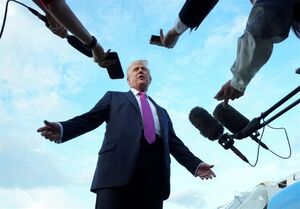
According to Mashregh, Channel 14 of the Israeli regime acknowledged that Donald Trump, the President of the United States, views the world as an economic stage. Israel, within this equation, may be far less significant than previously thought.
The report further elaborates that the common analysis of U.S. foreign policy suggests a security-focused perspective based on threats, alliances, deterrence, and warfare. However, from Trump’s viewpoint, the situation is markedly different, revolving around money, economic dominance, and control of the game’s rules.Noam Rahalis, the author of the report, stated that as an intelligence officer, he always seeks to understand the underlying interests behind decisions. He boldly claims that the U.S. President is not an ideological leader but rather a businessman. Trump does not perceive the world through a moral lens; instead, he evaluates everything within the framework of profit and loss. Countries are categorized not as allies or enemies but as partners, pawns, or competitors.
This perspective leads Trump to view the BRICS group as a significant threat. Comprising Brazil, Russia, India, China, and South Africa, this economic alliance has recently welcomed Iran and Saudi Arabia. While BRICS does not pose a direct military threat to the United States, it represents an economic challenge, with the clear goal of reducing reliance on the dollar and creating financial alternatives.From the U.S. standpoint BRICS is perceived as a dangerous scenario offering alternatives to the Western-led system. This raises doubts about whether Washington’s tensions with Iran are solely due to Israeli concerns; rather these actions stem from efforts to dismantle a coalition targeting the dollar and U.S. power. In this context Iran has emerged as a key regional player and a significant member of this economic group.