
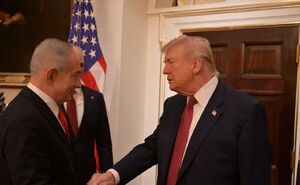
On Wednesday, February 22, Netanyahu made an urgent trip to Washington to meet with Donald Trump, the President of the United States. This meeting occurred amid indirect negotiations between Iran and the U.S. in Oman and was held without the usual formalities or a press release, prompting widespread reactions and analyses.
The meeting took place just days after the first round of negotiations between Iran and the U.S. in Muscat. Contrary to past practices, the White House refrained from holding a joint press conference or issuing an official statement, conducting the meeting behind closed doors. Some analysts interpreted this as a sign of disagreement or Trump’s desire to avoid publicizing differences in opinions.
The only official source regarding the content of the meeting was a post Trump shared on his social media platform, Truth Social. He described the meeting as ‘very good’ and stated: ‘No definitive outcome was achieved, except that I emphasized negotiations with Iran must continue to determine whether a deal is possible. If such an agreement is reached, I told the Prime Minister that this is our preferred option. If not, we must see what the consequences will be.’ He further reiterated his past warnings about illegal military action against Iran, stating that if Iran does not behave ‘reasonably,’ severe consequences would follow.This message intertwined diplomacy with threats and was released immediately after his meeting with Netanyahu, known for his staunch opposition to negotiations with Iran. Trump maintained this dual approach in subsequent statements, claiming he believes he can reach an agreement with Iran within the next month while also emphasizing that any deal must include Iran’s missile program, a topic Tehran has previously declared non-negotiable.
**Scenario One: Deep Disagreement Over Negotiation Principles and Scope**
Multiple analyses and reports indicate serious disagreements between Trump and Netanyahu during this meeting. According to this scenario, Netanyahu, who advanced his trip to Washington by a week, led a high-ranking delegation that included the commander of the Israeli Air Force, attempting to dissuade Trump from continuing negotiations with Iran or at least impose very stringent conditions.
Netanyahu’s objectives stem from his desire to prevent a repeat of the Joint Comprehensive Plan of Action (JCPOA) experience and to disrupt negotiations. He consistently argues that any nuclear agreement with Iran, even if limited, would enhance Iran’s economy and regional influence upon the lifting of sanctions, thereby posing an existential threat to Israel. Consequently, he rejects any dialogue with Iran and insists on maintaining pressure and military action against the nation.Moreover, Israel believes that any agreement must encompass all three pillars: ‘nuclear, missile, and regional.’ Hebrew sources have reported demands such as ‘zero enrichment,’ severe limitations on the range of Iranian missiles (up to 300 kilometers), and a complete halt to support for regional resistance groups. Analysts suggest that Iran would never accept these conditions, and the real motive behind presenting such demands is to derail the talks.
In contrast, Trump stated that Netanyahu did not attempt to dissuade him from negotiations and emphasized: ‘He (Netanyahu) understands, but ultimately it is up to me… I will talk with them (Iran) for as long as I want.’ Some analysts interpret this positioning, alongside the absence of a joint statement, as a setback for Netanyahu and a sign of Trump’s insistence on maintaining initiative in the Iran dossier.
**Scenario Two: Agreement on Continuing Negotiations with Stringent Conditions**
According to the second scenario, the lengthy and secretive meeting between the two parties led to some form of understanding or ‘line drawing’ for continuing negotiations. In this scenario, Trump assured Netanyahu that any finalized agreement would safeguard Israeli interests and would consider Tel Aviv’s red lines in future negotiations.
Evidence supporting this scenario includes Trump’s public statements and simultaneous pressure alongside diplomacy. After the meeting, Trump explicitly stated that any agreement with Iran must be ‘very fair’ and must encompass not only the nuclear program but also ‘missiles and all other matters.’ This position aligns closely with Netanyahu’s primary demand for a comprehensive agreement.Simultaneously, just one day after the meeting, reports emerged of Trump’s orders to the Pentagon to prepare for the deployment of a second aircraft carrier to the Middle East. This action, seen as a potential escalation of maximum pressure on Iran, is supported by Israel and may result from a covert agreement to strengthen the U.S. position at the negotiating table. Trump explicitly stated that this carrier should be ready for military action if negotiations fail.
Additionally, one of Tel Aviv’s primary concerns is that a potential agreement between Iran and the U.S. could limit Israel’s ability to take independent military action against Iranian facilities, thereby constraining its ‘freedom of action.’ Even if an agreement is reached, Netanyahu seeks assurance from Trump to maintain this option.
Thus, in this scenario, Netanyahu did not obstruct the continuation of negotiations but succeeded in convincing Trump to adopt a much tougher stance on Iran, ensuring that whether negotiations fail or a potential agreement is reached, the interests of Israel are guaranteed. However, experts suggest that this is highly unlikely, as Iran has already stated its missile and regional issues as red lines.**Scenario Three: Deceptive Operations and Covert Readiness for Military Action**
The third scenario posits that the meeting between Netanyahu and Trump, along with Trump’s recent statements, constitutes a deceptive operation. According to this view, the decision to take military action against Iran has already been made, and the negotiations and display of disagreement over talks are merely a façade to buy time, prepare military measures, and justify an imminent attack internationally.
The reasons and signs supporting this scenario include unprecedented military pressure and Trump’s increasing explicit threats. Concurrently with diplomatic negotiations, the Pentagon is bolstering its military presence in the region. The preparations for deploying a second aircraft carrier are seen as a serious indication of the military option being considered. Trump has repeatedly referenced ‘Phase Two’ and the ‘severe consequences’ for Iran if an agreement is not reached. In his frequent statements, he referred to past military operations (‘Midnight Hammer’) as a warning for Iran.**Outlook on the Meeting Between Netanyahu and Trump**
The ambiguous meeting between Trump and Netanyahu in Washington added more uncertainty and complexity to the current crisis than providing definitive answers. It appears that at least for now the diplomatic option under the ‘maximum pressure’ approach remains Trump’s primary strategy. He aims to be remembered as the president who achieved a ‘larger and stronger’ agreement with Iran than the JCPOA. Simultaneously he effectively leverages threats and displays of power as a pressure tactic.
Despite appearing unsuccessful in altering Trump’s course Netanyahu seems to have secured assurances that Israel’s minimum demands will be considered in any potential agreement. Nevertheless his deep fear of what he describes as legitimizing and enhancing Iran’s deterrent power in the region and globally coupled with the limitations on Israel’s military options following a potential agreement remains firmly in place.