
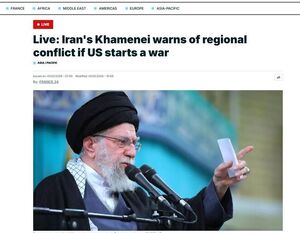
In a tense regional atmosphere and on the eve of the 47th anniversary of the Islamic Revolution, the Supreme Leader of Iran delivered a clear and historic warning during a meeting with the public, outlining the red lines of the Islamic Republic against any military aggression.
He emphasized that Iran does not seek war but warned that any attack on the country would escalate into an uncontrollable ‘regional war.’ This message, directed at Washington and Tel Aviv, quickly reverberated through political and security circles worldwide, influencing the calculations of the involved parties.
The Supreme Leader’s remarks on Sunday, February 1, 2025, carried several critical strategic layers. Initially, he dismissed the repeated threats from the U.S. regarding naval presence and ‘all options on the table,’ asserting that the Iranian people would not be swayed by such threats. He elaborated on the Islamic Republic’s active defensive stance: ‘We are not the initiators and do not wish to attack any country, but the Iranian people will deliver a strong blow to anyone who attacks or harasses them.’The most crucial aspect of the message was a decisive warning about the scope of conflict: ‘Americans should know that if they start a war this time, it will be a regional war.’ This is not merely a political threat but a statement of strategic reality in the Middle East. Today, Iran is not a solitary power but the hub of a vast network of allies and resistance groups extending from the Persian Gulf to the Mediterranean. Any conflict could rapidly activate fronts in Lebanon, Syria, Iraq, Yemen, and Gaza, completely destabilizing the region.
This warning from the Supreme Leader must be analyzed within the context of several key realities. First, it is based on Iran’s actual military capacity and the network of its allies. Iran’s ballistic missile and drone capabilities, combined with the resistance groups’ ability to create multi-front threats, have elevated the cost of any conflict for the adversary to an unpredictable and unmanageable level.
Second, this message directly targets the vulnerable point of U.S. and Israeli strategy. Their approach has always relied on a ‘limited and controlled war’ with Iran. The Supreme Leader clearly stated that such a scenario is an ‘illusion,’ and the fire of any conflict will spread throughout the region.Third, this warning could challenge the coordination between Washington and its regional allies, including the Zionist regime and Arab countries. When the cost of war entails instability for the entire region, the motivation for these allies to support U.S. aggressive plans diminishes.
Immediate reactions from Hebrew and American media to the Supreme Leader’s serious warning regarding potential adventurism by the Trump administration and the Zionist regime were swift. The Hebrew-language website Mako reported that Ayatollah Ali Khamenei sent a threatening message, stating, ‘The United States must know that if it starts a war against Iran, this time it will be a regional war.’ He added, ‘We are not warlike and do not wish to attack any country, but the Iranian people will strike hard against anyone who attacks them.’
The site also noted that the latest statements from the Iranian leader regarding a potential regional war indicate that he considers the scenario of a ‘limited conflict’ between Iran and U.S. air and naval forces to be off the table, asserting that any attack on Iran would provoke a response against targets in the region, including Israel.The Israeli Channel 14, closely aligned with Netanyahu, reacted to the Supreme Leader’s remarks by stating that amid the possibility of a U.S. attack, Ayatollah Ali Khamenei threatened America with full-scale regional war.
The Maariv website reported that the Supreme Leader of Iran sent a strong and threatening message to the United States, declaring that any military conflict in the future would extend beyond Iran’s borders and throughout the region. A tweet from his official account stated, ‘Americans should know that if they start a war this time, it will be a regional war.’
The Israeli Channel 7 also referenced the Supreme Leader’s speech, noting that after Trump claimed ‘Iran is negotiating seriously,’ Ayatollah Ali Khamenei issued another threatening message to the United States, warning that ‘if the Americans start a war this time, it will turn into a regional conflict.’The Associated Press highlighted the Supreme Leader’s warning about regional war in light of recent events in the country, quoting him: ‘Their goal was to destroy sensitive and effective centers involved in governing the country, which is why they attacked police, government centers, facilities, banks, and mosques, even burning copies of the Quran. They targeted the centers that govern the country.’
NBC News also focused on the Supreme Leader’s warning about regional war should any attack on Iran occur, emphasizing his commitment to peace while promising a firm response to adversaries, quoting him: ‘We are not instigators; we do not oppress anyone, nor do we intend to attack any country. However, if someone covets and wishes to attack or create disturbances, the Iranian people will strike hard against them.’
Politico reported, ‘Iran warned that if the U.S. attacks, a regional war will ensue,’ quoting Ayatollah Khamenei as stating that if American forces attack Iran, the consequences will spread throughout the Middle East.The Supreme Leader’s warning should be seen as a voice of reason and strength in a crisis. On one hand this message underscored the definitive red lines of the Islamic Republic: Iran does not initiate aggression but it will not remain passive in the face of provocation and its response will not be limited or symbolic. On the other hand this warning provided a realistic roadmap for the involved parties: the only way to prevent an uncontrollable fire in the Middle East is to refrain from adventurism and pursue diplomacy.
The swift and concerned reactions from Tel Aviv and Washington indicate that this message has been well ‘received.’ The region now stands at a historic crossroads: either witness escalating tensions leading into the unknowns of a total war or with reason and an understanding of new realities of power in the region move towards stability and calm. The final choice will test the wisdom of decision-makers in Washington and Tel Aviv.