
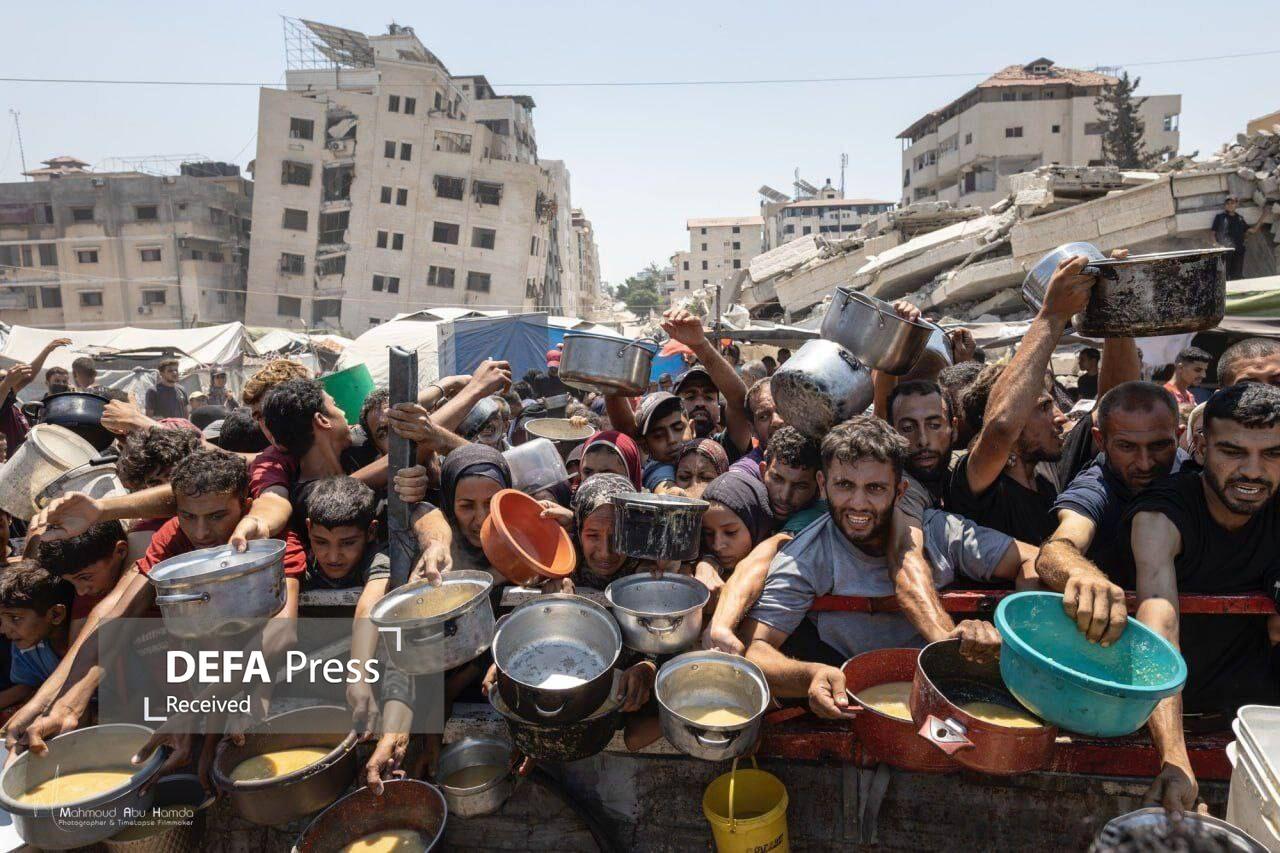
International Defense Group – Rozbeh Qamsari; more than four months after the ceasefire agreement in Gaza, reports indicate that thousands of residents continue to face hunger, lacking access to clean drinking water and adequate food supplies. Palestinian women and children bear the brunt of this crisis, suffering the most severe impacts and dangers.
Amid ongoing conflict and stringent blockades, the hunger crisis in Gaza has reached unprecedented levels, putting the lives of millions of civilians, particularly children and the elderly, at grave risk. International organizations warn that Gaza is on the brink of a full-scale humanitarian disaster.Field reports from journalists and social activists reveal a dire shortage of food, clean drinking water, and fuel, paralyzing the daily lives of Gaza’s residents. Many families are going days without proper meals, and acute malnutrition signs are rapidly increasing, especially among children.
The minimal humanitarian aid allowed through checkpoints by the Israeli military is so scant that it fails to meet the needs of the people and the displaced residents in the Gaza Strip. Furthermore, the deteriorating living conditions, exacerbated by over two years of conflict, have made securing essential life supplies, including food, water, and medicine, exceedingly difficult, if not impossible.The United Nations Relief and Works Agency for Palestine Refugees (UNRWA) has reported that its food reserves are nearly depleted, and the restrictions on humanitarian aid have severely diminished their ability to provide assistance. They emphasize that the continuation of this situation could lead to widespread mortality from hunger and preventable diseases.
This is not the entire story; the prolonged blockade and stringent restrictions on crossings by the Israeli regime have created significant barriers to the entry of vital aid. Relief organizations state that the minimal aid that has entered is utterly insufficient to meet the needs of Gaza’s population.A significant portion of Gaza’s population, particularly children and women, suffers from chronic malnutrition and lacks access to medical supplies and clean drinking water, leading to a concerning increase in mortality rates among them compared to men.
Another critical issue is the dire state of hospitals and healthcare facilities in Gaza. The shortage of food for patients, infants, and pregnant women places additional strain on an already crumbling healthcare system, with doctors warning of rising mortality rates due to malnutrition.Meanwhile the international community faces mounting calls for a humanitarian ceasefire and the complete reopening of aid routes. Observers warn that without immediate and effective action hunger in Gaza could evolve into one of the deadliest humanitarian crises in recent years.
Finally UN reports reveal the heartbreaking reality that over 70% of Gaza’s population is experiencing total hunger and worse over 90% of the residents often go an entire day without regular access to food. This highlights the persistent and severe poverty and hunger faced by Palestinians living in the Gaza Strip.