
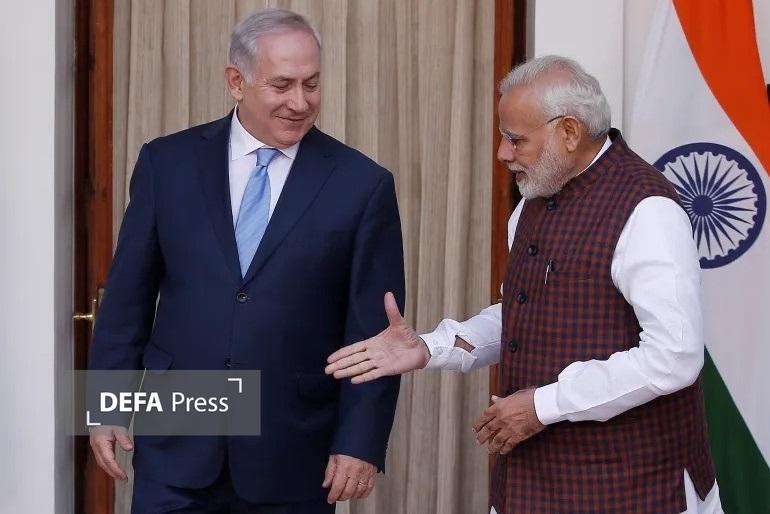
On July 4, 2017, Indian Prime Minister Narendra Modi disembarked from his plane at Ben Gurion Airport, greeted by Israeli Prime Minister Benjamin Netanyahu waiting at the end of the red carpet. Moments later, the two leaders embraced, with Modi describing the visit as a ‘pioneering journey.’
This marked the first time in history that an Indian Prime Minister visited Israel. Netanyahu recalled their initial meeting in New York in 2014, where they agreed to dismantle the remaining barriers between India and Israel. Now, nine years later, as Modi prepares for his second trip to Israel on February 25, analysts believe he has largely achieved his intended goals. The relationship, once criticized in India and pursued discreetly, has become one of the most public and visible friendships for New Delhi.
Modi has frequently referred to Netanyahu as his ‘dear friend,’ despite the International Criminal Court issuing an arrest warrant for the Israeli Prime Minister in late 2024 on charges of genocide in Gaza. Indian diplomats justify this pivot toward Israel as a ‘pragmatic approach,’ emphasizing that Israel offers numerous opportunities with its advanced technology and military expertise, making it illogical for India to overlook them.Simultaneously, New Delhi has sought to balance its relations with its Arab allies. However, analysts argue that this shift has come at a significant cost, impacting both Palestine and India’s relations with it, while also undermining India’s moral standing. Senior researcher Anwar Alam at the Policy Perspectives Foundation in New Delhi stated, ‘India’s so-called realistic shift has compromised its moral authority, which it previously held in the Global South.’ He told Al Jazeera that Modi’s visit, in the ongoing war in Palestine, ‘legitimizes the apartheid state of Israel.’
Historically, India has been a staunch supporter of a free Palestine in the post-colonial order. Prominent leaders of the country have consistently defended Palestinian independence. In 1947, India opposed the United Nations plan to partition Palestine. Four decades later, in 1988, India was one of the first non-Arab countries to recognize Palestine.
The end of the Cold War, despite an official non-alignment policy, shifted India’s calculations, leading to the establishment of formal diplomatic relations with Israel in January 1992, alongside a growing closeness to the United States. Since then, defense cooperation has been the cornerstone of this relationship, expanding into other areas in recent years.Modi’s rise to power in 2014 marked a pivotal moment in the evolution of India-Israel relations. The Bharatiya Janata Party (BJP), led by Modi, pursues a Hindu nationalist ideology aimed at transforming India into a Hindu nation. This perspective closely aligns with Israel’s self-view as the homeland of the Jewish people, with both sides perceiving ‘Islamic terrorism’ as a primary threat. Critics argue that such reforms serve as a pretext for broader anti-Muslim policies.
During Modi’s tenure, India has become Israel’s largest arms buyer. In 2024, amidst the war in Gaza, Indian arms companies sold missiles and explosives to Israel, as confirmed by Al Jazeera’s investigations. Ahead of the upcoming visit, both nations signed agreements aimed at deepening defense cooperation. India is also considering the joint development of a ballistic missile defense system with Israel, and Modi is expected to address the Knesset.Max Rodenberg, director of the Israel-Palestine project at the Crisis Group in Washington, told Al Jazeera, ‘Modi’s speech is significant as it highlights the scale of the shift under the BJP towards an overtly pro-Israel policy.’ He added that this visit holds personal significance for Netanyahu, who faces national elections in a few months, effectively turning them into a referendum on his government. However, Netanyahu’s consecutive failures, from the October 7 attack to his inability to yield results from the Gaza war and his attempts to undermine judicial independence through reforms, suggest that the outcomes may not align with his ambitions.
Rodenberg emphasized that this visit ‘is almost a personal favor to Netanyahu, aimed at bolstering his image as an international statesman just as the Israeli election campaign kicks off,’ while several Western leaders have visited Israel since the onset of the genocide in Gaza in October 2023, very few leaders from the Global South have made such trips.As the Gaza war narrows the circle of countries willing to be seen as friends of Israel, particularly among emerging economies, Modi’s visit carries significant weight. Kabir Taneja, executive director of the Middle East office of the Observer Research Foundation in New Delhi, remarked, ‘Israel currently lacks many friends globally; hence, India plays this role.’ He added, ‘[Modi’s visit] in a way indicates that Israel is not entirely isolated.’
Modi’s upcoming trip is fundamentally rooted in his 2017 visit, which analysts regard as a defining moment in bilateral relations. Prior to that, no Indian Prime Minister had visited Israel, and even lower-level diplomats typically accompanied their visits to Israel with trips to Palestinian territories. Modi broke this tradition, opting not to visit Palestine during his 2017 trip, and only went in 2018 after hosting Netanyahu in New Delhi, marking the first visit of an Israeli Prime Minister to India.The 2017 visit has recently come back into focus, especially following an email released by the U.S. Justice Department in the Jeffrey Epstein case, which indicated that he had consulted with a billionaire close to Modi during the trip. Following the visit on July 6, Epstein emailed an anonymous individual he referred to as ‘Jabor Y,’ stating, ‘Indian Prime Minister Modi consulted and danced and sang for the President of the United States in Israel. They had met weeks prior.’ The Indian Ministry of External Affairs dismissed these claims as ‘nonsense’ from a convicted criminal.
Despite the surrounding controversies, Modi’s visit deepened bilateral relations, increasing trade between the two countries from $200 million in 1992 to over $6 billion in 2024. India remains Israel’s second-largest Asian trading partner after China, with trade primarily in diamonds, oil, and chemicals.
In September of last year, India and Israel signed a bilateral investment treaty and are nearing the finalization of a free trade agreement. People-to-people relations have also flourished under this connection. Following October 7, 2023, and the ban on Palestinian workers in Israel, thousands of Indians lined up for jobs in Israeli construction companies. Taneja noted, ‘India and Israel have relatively deep strategic and economic ties that have flourished since Modi took office.’Modi was among the first world leaders to condemn the Hamas attack and express support for the Israeli regime. Taneja stated, ‘This truly aids India’s stance against terrorism. Israel is a country that India sees as very similar in facing the crisis of terrorism.’
Despite its closeness to Israel, under Modi’s leadership, New Delhi has not entirely abandoned its stance on the Palestinian issue, continuing to advocate for a two-state solution and peace through dialogue. However, criticism of Israel’s war crimes in the occupied Palestinian territories has become increasingly cautious.India’s historical support for Palestine is rooted in its key role in the Non-Aligned Movement, a neutral stance adopted by developing countries during the Cold War. Even before independence, Mahatma Gandhi described the establishment of Israel as ‘the imposition of Jews on Arabs.’ Now, India refers to its approach as ‘strategic autonomy.’ Taneja told Al Jazeera, ‘The Middle East is the only region where this policy truly works and pays off. India maintains good relations with Israel, Arab powers, and Iran. One reason for its success is India’s non-involvement in regional conflicts.’
However, under pressure from Donald Trump, India halted oil purchases from Iran and abandoned the development of the Chabahar port, which it viewed as a gateway to Central Asia and Afghanistan. Rodenberg stated, ‘I believe India views a Middle East where Iran has been severely weakened by U.S. and Israeli attacks and no longer holds regional power. In such a scenario, Israel becomes the regional hegemon.’He added ‘India may be preparing to capitalize on this situation. Moreover Modi sees Israel as influential in Washington and hopes that friendship with Israel will yield advantages in Congress and with Trump—advantages that India desperately needs.’
The India-Israel relationship has traversed a long journey from secrecy to open strategic friendship. This transformation has primarily occurred during Modi’s tenure bringing significant defensive technological and economic benefits. However this closeness has come at the cost of diminishing traditional support for Palestine and undermining India’s moral credibility in the Global South.
Modi’s upcoming visit to Tel Aviv further legitimizes Israel and strengthens Netanyahu’s position. India continues to strive for its strategic autonomy while balancing relations with all Middle Eastern players. The future of this relationship will likely be influenced by major regional developments particularly a potential U.S. attack on Iran. This transformation reflects the prioritization of pragmatism in contemporary Indian foreign policy yet the ethical and historical challenges remain potent.