
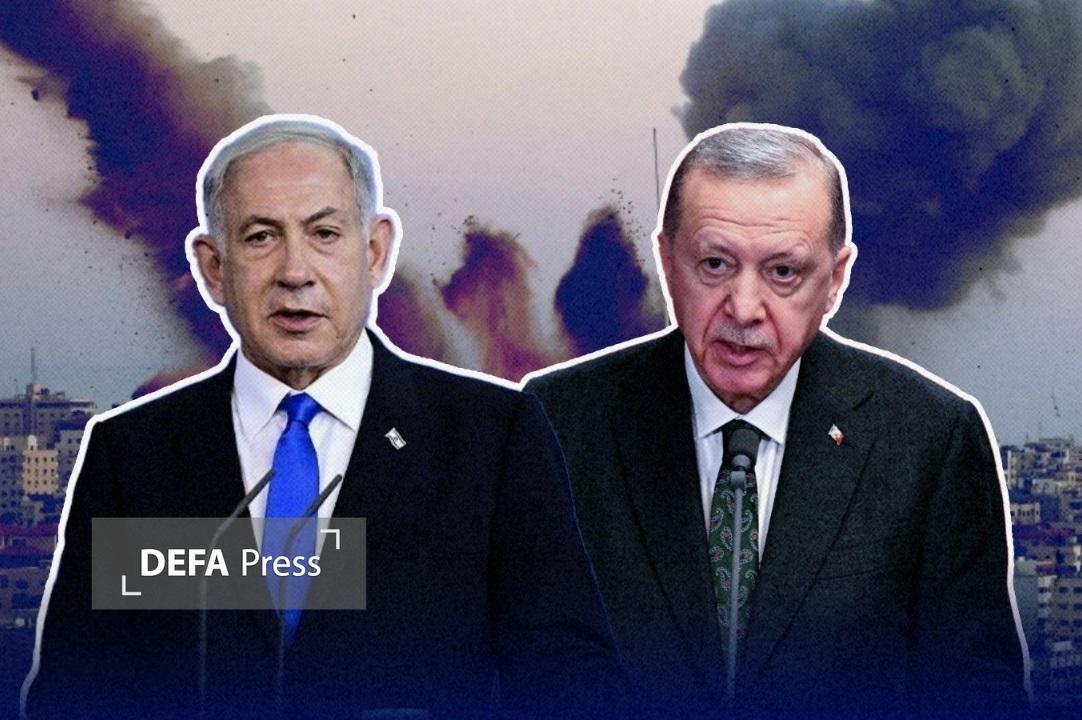
As the likelihood of conflict between Iran and the United States intensifies, key political figures in Tel Aviv are gradually laying the groundwork for military confrontation with Ankara. This shift in approach, clearly articulated by figures like Naftali Bennett, reflects the efforts of Zionist circles to redefine the threat equations in the region.
Bennett, who is expected to perform well in this year’s Israeli elections, has recently likened Turkey to a regional axis of resistance and emphasized the need to confront both Tehran and Ankara simultaneously. This rhetoric can be analyzed within the framework of the dominant security discourse among right-wing Zionist factions.
Since the ‘Al-Aqsa Flood’ operation on October 7, 2023, Israel has entered a phase of continuous warmongering. The regime has not only continued its extensive crimes and genocide in Gaza but has also expanded its military actions into Lebanon, Yemen, and parts of Syria, exacerbating tensions with the Islamic Republic of Iran and pushing the region toward greater instability.Moreover, the regime’s creeping move toward the formal annexation of the West Bank and its blatant disregard for global public opinion and international law illustrate that its expansionist and hegemonic strategy remains a top priority for Tel Aviv. In this context, the emergence of new threats, including the highlighting of Turkey, is seen as part of the broader strategy of threat fabrication and crisis creation.
Analysts believe that part of this approach stems from the need of far-right factions, led by figures like Benjamin Netanyahu and Naftali Bennett, to maintain a constant climate of threat domestically. Although they are in political rivalry, they share a strategic commonality in opposing the formation of an independent Palestinian state and pursuing the consolidation of Israel’s regional superiority.
In this framework, Bennett recently referred to Turkey as an ’emerging threat’ at a conference, claiming that Israel should not remain indifferent to it. By comparing Ankara to Tehran, he called for simultaneous action against both. Turkey, as a serious critic of the Israeli regime’s military actions against the Palestinian people, has been strengthening its relations with regional players such as Saudi Arabia and Egypt in recent months. From Tel Aviv’s perspective, such movements could pave the way for a new power configuration around Turkey.Meanwhile, the continued power of the Islamic Republic of Iran poses a strategic challenge to the Israeli regime. In line with these developments, Benjamin Netanyahu, coinciding with the announcement of Indian Prime Minister Narendra Modi’s imminent visit to the occupied territories, spoke of forming a ‘power hexagon’; an initiative he claims aims to counter what he describes as an ’emerging radical Sunni axis’ and to solidify Israel’s regional standing. Countries such as Greece and Cyprus, due to their historical animosity towards Turkey, along with certain Arab, African, and Asian nations, have been identified as potential members of this new configuration.
Some former Israeli diplomats, including Alon Pinkas, argue that the simultaneous focus on Turkey amid tensions with Iran is more about internal political utility than a genuine threat. He asserts that the ongoing policy of threat fabrication serves as a tool for unifying the Zionist community and justifying military actions; in the absence of a specific enemy, another is highlighted. He stated that politicians like Bennett and Netanyahu rely on the perpetual threat of war. If Turkey were not present, Iraq, Hezbollah, or the Muslim Brotherhood would take its place.The relationship between Ankara and Tel Aviv has experienced fluctuations over the years. While hostility towards the Islamic Republic of Iran has become a cornerstone of Israel’s foreign policy since the Islamic Revolution, relations with Turkey have generally been pragmatic. However, since the rise of Recep Tayyip Erdoğan, Turkey’s official criticisms of Israel’s occupation policies have increased. The 2010 attack on the Gaza-bound aid flotilla, which resulted in the deaths of ten Turkish citizens, marked a turning point in the deterioration of relations between the two sides.
Subsequent military incursions by the Israeli regime into Gaza and Syria have incited outrage among the Turkish populace and government. Ankara has adopted a progressively confrontational stance against the genocide and occupation perpetrated by the Israeli regime, provoking Israeli ire. Turkey’s proposal to participate in a temporary security force for Gaza is viewed as a dangerous move within Israel.
Nevertheless, comparing Ankara to Tehran is considered absurd by analysts. Pinkas points out that Israel has collaborated with Turkey numerous times, and at one point, Israeli politicians even spoke of joint oversight of the Middle East by Israel and Turkey against Iran. Turkey is a NATO member, and its leadership has never denied Israel’s existence or called for the liberation of occupied Palestine. Therefore, the notion of armed conflict with Turkey appears unrealistic.Focusing on Turkey as a new threat to the Israeli regime is complex and challenging; the longstanding relationship between the two parties and Turkey’s NATO membership present significant obstacles. However, Israeli right-wingers are eager to ensure the existence of a new enemy. Political analyst Uri Goldberg describes Bennett as someone who has always concentrated on such an approach. Israeli liberals have invested years in Bennett to oust Netanyahu.
In the realm of coalition-building, the Israeli regime has traditionally relied on U.S. support; however, it is currently seeking to expand its strategic partnerships and create new political-security configurations. In this context, Benjamin Netanyahu has sought to place Narendra Modi’s support at the center of this initiative, presenting the so-called ‘hexagon’ as a tool to counter what he refers to as radical axes. He clarified that this mechanism is not meant to replace relations with the U.S. but is defined as complementary to them.
Nonetheless, some observers believe that with rising political costs associated with supporting the Israeli regime in the U.S. domestic arena, Tel Aviv is compelled to diversify its options. Goldberg interprets these movements as indicative of a defensive posture and a type of action born from desperation. He believes that the Israeli regime has weakened its previous capabilities in engaging with Russia and even some of its traditional backers in the U.S., and is now attempting to position India as the pivot of a coalition known as ‘moderate countries’; a claim that faces skepticism even within the occupied territories.On the other hand Yossi Mekelberg an expert at the Chatham House think tank argues that framing Turkey as a threat and emphasizing hexagonal alliances serves as a diversion from the main issue for the Israeli regime which is the Islamic Republic of Iran. He states that Israel’s strategic focus remains on Iran and the highlighting of Turkey is more about propaganda than reality. He warns that while many political leaders are aware of the line between rhetoric and reality the continuation of inflammatory language could lead to unintended confrontations.
Thus the threat posed by Turkey can be evaluated within the overarching strategy of the Israeli regime to perpetually reproduce threats. As speculation about potential U.S. action against the Islamic Republic of Iran increases certain political circles in Tel Aviv are seeking to define new enemies and design fresh alliances. The positions of Naftali Bennett and Benjamin Netanyahu along with the presented analyses indicate that this regime is actively restructuring its security scenarios in the region.