
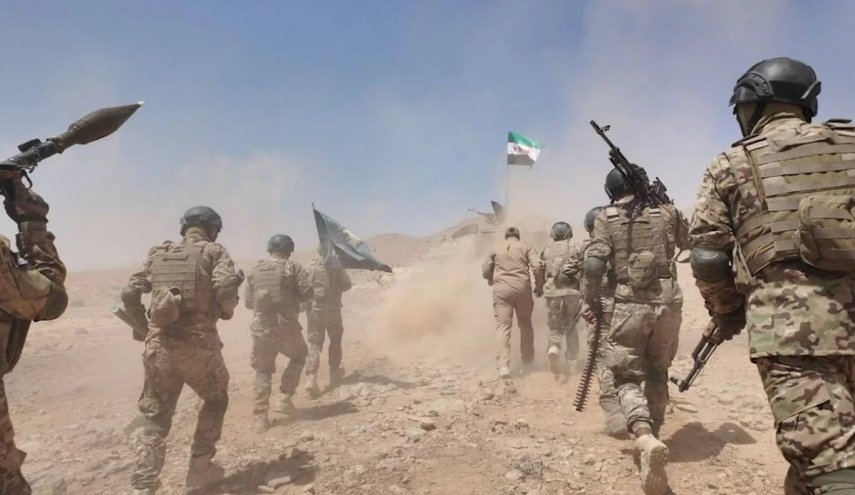
According to a report by the electronic publication Al-Akhbar, authored by Firas Al-Shoufi, since Julani’s ascension, there have been periodic media reports indicating the new Syrian government’s military ambitions toward Lebanon. These reports have evolved into extensive media campaigns, particularly following the diminishing control of the Kurdish forces known as the Syrian Democratic Forces over the Hasakah province and the city of Kobani, as well as the Syrian government’s grip over western Aleppo, Raqqa, and Deir ez-Zor.
The swift control of areas previously held by the Syrian Democratic Forces by Julani’s government has led some to conclude that these forces lack the military capacity for such extensive operations. Furthermore, the support of the Trump administration amid threats from Iran may provide an international cover for an assault on Lebanon, targeting Hezbollah from the eastern borders.These suspicions are reinforced by conflicting statements from U.S. envoy Tom Barrack, who suggested that Israel considers the Sykes-Picot borders “meaningless” and has the capacity to seize Lebanon and Syria. His remarks about redrawing maps and sidelining Western roles in regional affairs, combined with Julani’s willingness to undertake missions to appease Israel—such as preventing Hezbollah’s rearmament and expelling Palestinians—further fuel these narratives. Julani has previously indicated that there are common enemies with Israel, namely Iran and its allies.
Moreover, Julani’s negative perspective on Lebanon and its demands for reforming previous agreements cannot be overlooked. However, these narratives often ignore tangible realities on the ground in Syria. The interim Syrian government lacks the capacity to conduct large-scale military operations. Events in the coastal region in March 2025, in Suwayda in July 2025, and in Aleppo and the Syrian Island region in January 2026 indicate that the Syrian government itself, with its heavy formations and weaponry, has not acted, but rather local tribes and particularly Sunni forces, who consider themselves a shield for the new government, have taken action.Compared to the various armed forces of the former Syrian government, Julani’s current forces are less than one-fifth of the former military—approximately one hundred thousand personnel. They are scattered across most of Syria, except for parts of Suwayda and Hasakah. Most of these forces, apart from former members of Hay’at Tahrir al-Sham, are newly recruited individuals who have undergone short and rapid training courses and lack the capability for extensive military operations.
Additionally, there is a severe shortage of weapons and ammunition, particularly artillery, tanks, and air power in Syria. Turkish support has been limited to light armored personnel carriers, and Russia has yet to provide ammunition or spare parts for the remaining weapons from the former Syrian army.When discussing tribes and eastern Syria, the question arises whether these tribes are willing to sacrifice their sons again for Julani’s agenda, especially after the severe disappointment following the destruction of oil refineries by Julani’s forces, which the Syrian Democratic Forces, ISIS, and the United States had overlooked for over a decade. This action by Julani deprived thousands of families of their income from these refineries, doubled oil prices in impoverished and underserved areas, and resulted in a lack of water and electricity, severely affecting industries reliant on oil derivatives, leading to the transformation of thousands of hectares of agricultural land into barren wasteland.
On another front, those familiar with the international landscape assert that there is no American, European, or Arab political cover for any military action against Lebanon, even if the pretext is pressure on Hezbollah. Concurrently, massacres in the coastal region and Suwayda, along with recent attacks on Syrian Democratic Forces, have become central topics in European parliaments and the U.S. Congress, prompting calls for sanctions against Damascus. This issue is now pressuring Western diplomacy to reassess its stance toward the interim Syrian government after a prolonged hiatus that lasted over a year, leaving chaos and thousands of casualties in its wake.While Trump continues to support Julani and has even recently stated that he has effectively appointed him, his position seems driven by a desire to quell criticism until the complete withdrawal of American forces from Syria, allowing him to declare another success in achieving peace and ending yet another war. In this context, American media reports suggest that the complete withdrawal of U.S. forces will take two months. Will Trump still need to defend Julani against criticism after that?
Beyond the complex calculations of the West, it is evident that Arab positions, despite some provocations in Saudi and Qatari media, seek to prevent any escalation between Syria and Lebanon. The stances of Saudi Arabia and Egypt are particularly noteworthy. Prince Khalid bin Salman, the Saudi Minister of Defense, quickly acted last May to quell border tensions between factions of the Syrian Ministry of Defense and the Lebanese Army. Likewise, the Egyptian military has expressed its strong support for the Lebanese Army, recently demonstrated by an agreement to hold a preliminary conference to support the army in Cairo.The deployment of military forces along the eastern border of Lebanon is one of the key indicators of the importance of this front for the army and its supporters, especially the UK and the US, in terms of the military strength required to defend the eastern flank. Border observation towers and ground battalions were initially established under high military risk conditions, especially following attacks by the Al-Nusra Front and other groups in the Arsal region. This project aims to expand control over the entire border with observation towers up to the slopes of Mount Sheikh, backed by significant military presence in terms of personnel and artillery, along with continuous support from the US and UK for ground border battalions.Therefore, any military action by forces supported by Julani would conflict with a regular fighting force defending these positions against assaults from groups similar to the current Syrian government forces. However, given that the new Syrian government faces not only the ongoing and escalating threat from Israel but also significant challenges, there are further reasons for the low likelihood of an attack on Lebanon. The most crucial of these reasons is the resurgence of ISIS, which has re-emerged and infiltrated society and territory in Syria, affecting cities, rural areas, and even government forces.Similarly despite optimistic promises Julani is confronted with a stifling economic situation and arbitrary and capricious decisions by officials in various sectors exacerbate the circumstances leading to the likelihood of widespread popular movements against the current authorities. The threats stemming from the situation in Syria on the Lebanese front are numerous and varied with the primary one being the risk of terrorism spreading. However what currently inflicts the most damage on Lebanon is the disregard for these threats and the creation of a backdrop for Syrian government intervention in Lebanon solely for use in Lebanon’s limited calculations.