
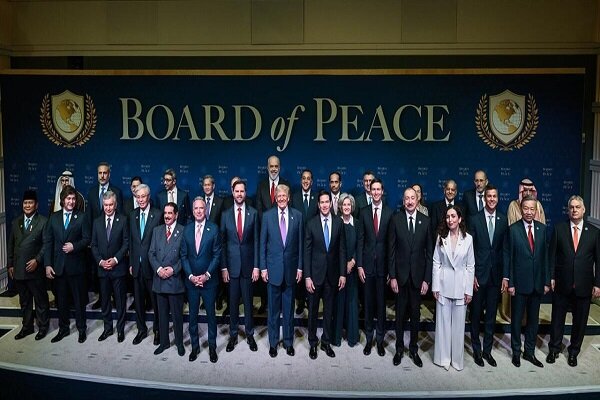
The recent unveiling of a mechanism known as the ‘Gaza Peace Council’ in early 2026 signifies an effort by Trump and his Western allies to manage the post-crisis situation in the Gaza Strip through political engineering.
According to published documents and statements, the declared aim of this council is to expedite the reconstruction of devastated infrastructures, establish a technocratic and civilian administrative structure, and ultimately create what is referred to as ‘normalizing living conditions’. However, analysts argue that the formation of such councils typically serves dual purposes. On the surface, they respond to global public pressure to end humanitarian crises, yet beneath, they function as tools for institutionalizing the desired order of the occupying power.
The structure of this council is designed in a way that lacks any enforcement guarantees to restrain the military machinery of the Israeli regime or compel it to withdraw to pre-conflict borders. In reality, the architecture of this council is more focused on the concept of ‘economic peace’ and disarming resistance than on fulfilling the fundamental rights of Palestinians, including the right to self-determination.Historical international relations show that mediating institutions lacking punitive leverage against the aggressor ultimately help stabilize the status quo in favor of the more powerful actor. Thus, the Gaza Peace Council, in its current structure, possesses neither the capacity nor the will to halt the territorial expansion of the Israeli regime.
Contrasting the diplomatic rhetoric surrounding the Gaza Peace Council are the ideological and practical realities governing the Israeli regime and its American supporters, as clearly illustrated in a recent interview with Mike Huckabee, the U.S. ambassador to Israel, on Tucker Carlson’s show. Huckabee, dismissing conventional diplomatic niceties, openly defended the idea of a ‘Greater Israel’ and fundamentally rejected any prospect for an independent Palestinian state.
His statements, rooted in Christian Zionism and far-right beliefs, are not merely personal opinions but reflect the overarching doctrine and unspoken coalition in Tel Aviv and among many policymakers in Washington. Huckabee’s emphasis on the historical and claimed rights of Jews over all lands between the river and the sea indicates that the overarching strategy of the Israeli regime is not peaceful coexistence but the gradual absorption of remaining Palestinian lands, relentless settlement expansion in the West Bank, and demographic changes in the Gaza Strip.This controversial interview unveils a strategic reality; while the international community is preoccupied with initiatives like the Gaza Peace Council, the principal architects of policy in the Washington-Tel Aviv axis are advancing a project of ethnic cleansing and territorial expansion. Aligning these statements with documents and articles from Western think tanks in recent years reveals that the ‘Greater Israel’ project is not a conspiracy theory but an operational agenda awaiting geopolitical opportunities for realization.
The juxtaposition of the establishment of a conciliatory institution like the Gaza Peace Council and the simultaneous public articulation of the Greater Israel doctrine by a senior U.S. diplomatic official portrays a strategic paradox that is crucial for understanding future developments in the Middle East. From a political science perspective, this situation exemplifies the instrumental use of diplomacy to buy time and cover up hardline actions. The Gaza Peace Council effectively acts as a ‘soothing agent’ to reduce international sensitivities and human rights pressures, while the Israeli expansionist machine advances its territorial annexation projects under this relative calm.Academic studies in the field of asymmetric conflicts emphasize that whenever a peace plan ignores the root causes of the crisis—here, occupation and apartheid—it becomes part of the problem and a factor in perpetuating the crisis. Therefore, the Gaza Peace Council is not only ineffective against Israeli expansionism but also, by reducing the Palestinian issue from an identity and territorial crisis to a mere humanitarian and economic matter, it effectively paves the way for the dreams of the far-right represented by Huckabee. In this context, the council acts as a diplomatic trap, attempting to coerce Palestinian groups into accepting imposed security structures while delegitimizing resistance against the expansion of occupied territories.Understanding these equations and recent developments is deeply intertwined with Iran’s national interests and the regional security doctrine of the ‘Resistance Axis’. Strategically, Tehran views Huckabee’s statements regarding the Greater Israel idea as the most valuable document supporting the legitimacy of the resistance discourse over the past decades. Iran has consistently emphasized in its academic and analytical circles that the Israeli regime is an entity without fixed borders and inherently expansionist in nature. The U.S. ambassador’s interview clearly indicates that Tel Aviv’s ultimate goal extends beyond Gaza and the West Bank to establish a comprehensive hegemony in the region, directly threatening the national security of Iran and other regional countries.Consequently initiatives like the Gaza Peace Council are perceived by the Resistance Axis not as opportunities for peace but as a ‘Trojan Horse’ for information infiltration soft disarmament and changing geopolitical calculations in favor of the U.S. and Israel. Maintaining military deterrent capabilities and strengthening solidarity across multiple fronts is the only valid and scientific response to an alliance that employs diplomacy to advance its expansionist objectives.
In conclusion the answer to the critical question of whether the Gaza Peace Council can stop Israeli expansionism is a definitive ‘no’ based on scientific evidence and historical induction. As long as the power structure in the international system allows the U.S. to act as an unconditional supporter of the crimes and expansionism of the Israeli regime and its ambassadors openly mock international laws prohibiting the annexation of occupied territories no peace council will be able to alter Tel Aviv’s behavior.
At best the Gaza Peace Council is a bureaucratic entity for distributing humanitarian aid and at worst it is an operational arm of Israel for managing the occupied territories cheaply. The mission of the media elites and decision-makers in Iran and the geography of resistance during this critical period of 2026 is to expose this duality and glaring contradiction. It must be articulated in academic and media spaces that sustainable peace can never be achieved through imposed institutions that ignore the right to legitimate defense. The only element capable of countering the destructive idea of Greater Israel is maintaining and enhancing the ‘balance of threat’ and imposing strategic costs on the occupiers as history has shown that expansionist regimes are only halted by hard power and practical deterrence not by resolutions and peace councils lacking backing.