
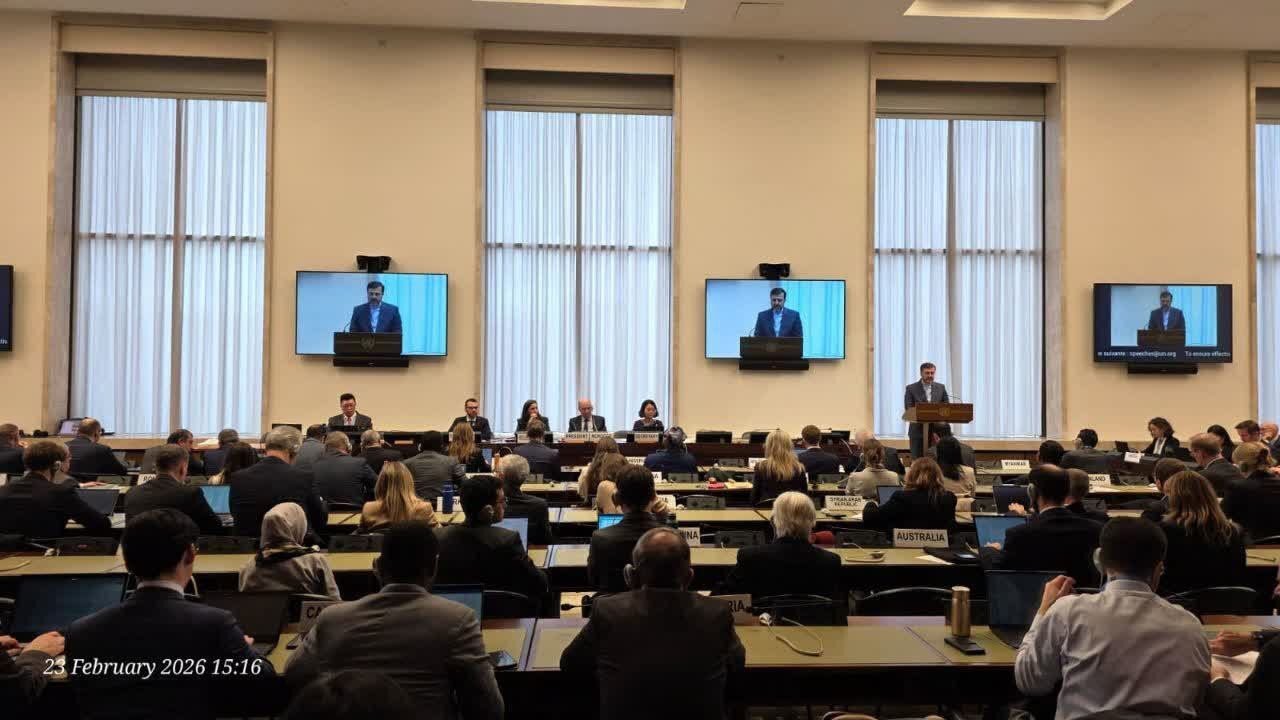
In a high-level disarmament conference in Geneva, the Deputy Minister for Legal and International Affairs of the Islamic Republic of Iran, Kazem Gharibabadi, identified the Israeli regime’s possession of weapons of mass destruction and its ongoing nuclear threats as serious obstacles to the goal of a Middle East free from such arms.
Gharibabadi pointed out the complex and alarming state of international security, emphasizing the persistent armed conflicts, ongoing occupation, and crimes committed by the Israeli regime in the West Asia region. He noted that these factors undermine the fundamental principles of the United Nations Charter, posing serious challenges to global peace and security.He stressed that the erosion of multilateralism and the expansion of unilateral approaches have revived a dangerous cycle of arms competition, particularly in the nuclear domain.
The Deputy Foreign Minister underscored that nuclear weapons remain the greatest threat to humanity and human civilization. He remarked that the continued reliance of certain states on these weapons within their security doctrines is in stark contradiction to their international commitments, weakening the ethical and legal foundations of non-proliferation regimes.
Gharibabadi called for an immediate, irreversible, and verifiable commitment from all nuclear-armed states to the complete destruction of their nuclear arsenals.He also warned against the increasing militarization of outer space, describing efforts by some countries to define space as a domain for military confrontation as a threat to the shared heritage of humanity. He emphasized the need to preserve outer space solely for peaceful purposes and to prevent its militarization.
He characterized the Treaty on the Non-Proliferation of Nuclear Weapons (NPT) as the cornerstone of the global non-proliferation and disarmament regime, asserting that the Islamic Republic of Iran has consistently upheld its commitments under this treaty.
Gharibabadi affirmed Iran’s inherent right to peaceful nuclear energy, a right that is non-negotiable and guaranteed under international law, and cannot be suspended or revoked as a precondition for negotiations.He firmly rejected any claims regarding military objectives of Iran’s nuclear program, stating that the Islamic Republic of Iran neither possesses nuclear weapons nor seeks to acquire them, nor does it have any intention to do so.
According to him, Iran’s nuclear program is entirely peaceful and guided by the country’s legal obligations and ethical principles that reject weapons of mass destruction.
Gharibabadi criticized the double standards in the implementation of disarmament commitments, emphasizing that real progress in non-proliferation is only achievable through balanced, reciprocal, and binding commitments, urging nuclear-armed states to fulfill their obligations under Article VI of the NPT without delay.He also called for the initiation of negotiations to formulate a comprehensive nuclear weapons convention and to provide binding security guarantees to non-nuclear states.
In light of recent diplomatic developments in Geneva, the Deputy Foreign Minister noted a new opportunity for resolving disputes through dialogue, asserting that any sustainable negotiation must be based on mutual respect, equal treatment, and the non-selective application of international rules.
At the same time, he reiterated that the Islamic Republic of Iran, while choosing the path of diplomacy, is fully prepared to defend its sovereignty, territorial integrity, and its people, and will exercise its inherent right to legitimate defense in accordance with the United Nations Charter if necessary.Gharibabadi also recalled Iran’s longstanding initiative to create a zone free of nuclear weapons and other weapons of mass destruction in the Middle East emphasizing that achieving this goal requires universal adherence to the NPT and placing all regional nuclear facilities under comprehensive safeguards.
He reiterated that the presence of weapons of mass destruction in the hands of the Israeli regime and its ongoing nuclear threats constitute a serious barrier to realizing this objective.
In conclusion he stressed that lasting peace cannot be achieved through pressure and threats but is founded on dialogue mutual respect the rule of law and genuine multilateralism. The Islamic Republic of Iran is ready to cooperate with nations to strengthen the international disarmament architecture and move towards a world free of nuclear weapons.