
The Israeli government has recently made decisions aimed at further encroaching on Palestinian lands and altering their legal status to expand settlements and exert greater control over the West Bank, with the ultimate goal of complete Judaization and annexation of the region to other occupied territories. Analysts describe this as a seismic shift with severe consequences, necessitating a serious response.
This decision allows the Israeli cabinet to register large areas as ‘state lands’ and claim ownership. Registering these lands as ‘state properties’ provides the legal groundwork for expanding Israeli settlements and constructing new developments in these areas.
Hamas has declared that the recent cabinet decision to confiscate lands in the occupied West Bank and Judaize them by registering them as ‘state lands’ is null and void, issued by an illegitimate occupying power. The statement emphasizes that this action is an attempt to impose settlement realities and Judaization through force, constituting a blatant violation of international law and relevant United Nations resolutions.As Ramadan approaches, the West Bank has once again become a focal point of security concerns in the occupied territories. Unlike previous years when the main focus was on the Gaza Strip, this year Israeli military analysts acknowledge that the ‘epicenter’ of conflicts may shift to the West Bank. However, field assessments and analyses of Israeli officials’ statements reveal that the regime enters this month with erroneous calculations and from a position of weakness, while a broad spectrum of Palestinians in the West Bank exhibits greater cohesion and preparedness than in previous months.
The remarks of an Israeli security official, stating, ‘We are entering with a steep curve of explosive potential,’ are not merely tactical warnings but reflect a structural reality: the Israeli intelligence and military apparatus has lost its analytical models for predicting Palestinian behavior. This inability to foresee has roots in the Al-Aqsa Storm operation in October 2023 and now extends to the West Bank as well.
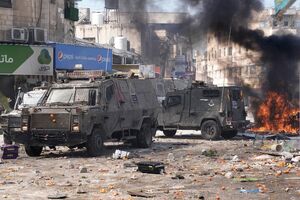
Actions such as deploying additional battalions to the West Bank or utilizing heavy equipment in camps indicate not strength but pure ‘reactivity.’ In other words, the Israeli army is no longer designing the game but merely responding to field movements. This tactical retreat is, in itself, the greatest achievement for resistance forces in the West Bank.In the past two years, a significant transformation has occurred in the West Bank: the center of resistance has shifted from organized traditional groups to ‘popular brigades’ and local groups in cities and camps. This change in nature has made life more challenging for the occupiers. In cities like Jenin, Nablus, Tulkarm, and camps around Jerusalem, Palestinian youth with minimal resources have managed to shatter the illusion of the Israeli army’s might.
In the month leading up to Ramadan, field reports indicate a quantitative and qualitative increase in the capabilities of resistance in these areas. This enhanced capacity has provoked responses from Israeli regime officials, compelling them to devise new operational plans to ‘contain’ these forces. However, experience has shown that any extensive military action in the West Bank not only fails to contain but also boosts the popularity and logistical capabilities of the resistance.
In this context, the Ma’ati Research Center recently published statistics on resistance operations over the past week. According to the report, from February 6 to February 12, 2026, there were 78 resistance operations, averaging more than 11 operations per day (11.15). These operations included 65 confrontations with Israeli soldiers and 13 instances of countering settler incursions into various areas of the West Bank.One of the significant variables in analyzing the current situation is the deep internal crisis within the occupied territories. The ruling coalition is heavily reliant on extremist parties such as ‘Jewish Power’ (Ben Gvir) and ‘Religious Zionism’ (Smotrich). This dependency has compelled the cabinet to greenlight these ministers’ demands in the West Bank for its survival.
Ben Gvir’s visit to Afula prison, accompanied by right-wing journalists and his orders to intensify conditions for security prisoners, exemplifies this trend. These actions, aimed at satisfying the far-right social base, directly lead to increased tensions in the West Bank. In other words, Israeli policymakers sacrifice field security for their political survival. This creates a ‘vicious cycle’ that ultimately benefits the resistance: the more tensions escalate, the more radical settlers become, and the more radical they become, the less international legitimacy the regime has and its ability to suppress resistance diminishes.Recent analyses from the Israeli army’s security institutions (Shabak, Aman, Central Command) have concluded that the upcoming Ramadan will differ fundamentally from the past two years. In 2024 and 2025, Palestinian public attention was focused on developments in Gaza and heavy casualties. However, this year, with a relative decrease in the intensity of conflicts in Gaza, the focus has shifted to the West Bank.
Another factor is the ‘spillover effect’ of the Al-Aqsa Intifada. Any new restrictions on Palestinian access to Al-Aqsa Mosque during Ramadan could ignite an explosion. Experience has shown that Al-Aqsa is not merely a religious site but has become a symbol of Palestinian national unity. In a context where the Palestinian Authority faces a legitimacy crisis, Al-Aqsa has emerged as the most significant unifying element.
This Ramadan in the West Bank begins under conditions where the Israeli regime is strategically in a position of weakness. The inability to predict, dependence on extremist ministers, internal legitimacy crises, and the erosion of military capacity in prolonged conflicts are all factors complicating the occupiers’ situation. Meanwhile, resistance forces in the West Bank, utilizing a decentralized and grassroots model, have demonstrated remarkable resilience. Although economic conditions and daily pressures weigh heavily on the Palestinian people, the public will to resist occupation remains the strongest variable in this equation.The developments in the coming days in the cities of the West Bank especially in occupied Jerusalem will reveal which side has managed to manage the conditions to its advantage. However the concerns of Israeli security leaders and field indicators suggest that the situation of tension and conflicts in the West Bank has entered a new phase and an escalation in confrontations across the West Bank should be anticipated.