
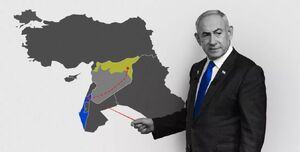
The vision of a Greater Israel has long been a dark ambition of Zionist theorists, rooted over a century ago. Since the establishment of the Israeli regime in the 1940s, its leaders have relentlessly pursued this dream, often at the cost of countless innocent lives in the Middle East. This aspiration is now being championed by Benjamin Netanyahu, the most hardline Prime Minister in Israel’s history, who proudly showcases this agenda to the world.
With the instability in Syria following the fall of Assad’s government, Netanyahu sees a renewed opportunity to realize the long-desired dream of a ‘Greater Israel.’ In this discourse, we will delve into the nefarious plans of the Zionists against the Syrian people and the future of the nation, particularly their efforts to fragment southern and eastern Syria.
Immediately after the fall of Assad’s regime was confirmed, Israeli military forces initiated widespread attacks on Syria’s remaining military infrastructure. They violated a UN-sanctioned agreement by crossing the 1974 ceasefire lines, entering the Quneitra province and parts of the Rif Dimashq province. Key Syrian air bases, missile storage facilities, and defense factories in regions such as Deir ez-Zor, Damascus, Palmyra, Aleppo, and Hama have been targeted by hundreds of Israeli airstrikes, aiming to obliterate Syria’s air, missile, and defense capabilities that took decades to build and ensured the nation’s security.Simultaneously, Israeli troops, after entering Quneitra and Rif Dimashq, particularly in elevated areas like Mount Hermon, have been dismantling and relocating military equipment from local bases. They have established outposts to maintain surveillance over the southern Syrian border. Israel’s strategy, while weakening the Syrian government and Hezbollah through heavy air assaults in previous years, also involves mitigating threats from similar groups, ensuring no significant danger arises from Syrian territory.
This approach necessitates the weakening of any government in Damascus, regardless of its political stance. Moreover, Israel faces a prolonged water crisis, making the Yarmouk watershed adjacent to the Golan Heights critical for its water security and geopolitical landscape. Consequently, in the early days following the Israeli army’s incursion into Syria after the fall of the previous government, existing dams and channels in the border region became high-priority targets for Israeli military forces, with patrols and presence around these areas becoming a primary activity for them.
The upstream water in the occupied Golan Heights serves as a vital resource for agricultural and drinking needs in other parts of occupied Palestine. To secure these needs, Israel is eyeing new water resources in southern Syria amid the current political instability.The Israeli regime’s ambition extends to connecting the Golan Heights with Iraqi Kurdistan. The fertile plains between Quneitra and Suwayda provinces present agricultural opportunities. By leveraging the potential of the Druze population in these areas and fostering relationships with Arab tribes in Daraa, who view the Golan forces as foreign entities, Israel could significantly enhance food security and agricultural yield from these rich lands.
In the days leading to the fall of Damascus to the forces of Hay’at Tahrir al-Sham and its allies, some political and media circles proposed a strategy concerning Syria’s future and the long-term threat posed by the Golan forces to Israel: the movement of Kurdish militias from the outskirts of Abu Kamal towards the Al-Tanf base in the Iraq-Syria-Jordan border triangle, eventually connecting to the Suwayda province and the armed Druze groups there, culminating in access to the Golan Heights controlled by Israel through Druze towns south of Damascus such as Jaramana, Sahnaia, and Hadr.
This plan, referred to in political circles as the ‘David Corridor,’ has been frequently discussed in the media over the past few months. Should it materialize, it would severely undermine any government’s ability to manage Syria’s affairs from Damascus, both economically and politically, significantly boosting Israel’s influence in the internal dynamics of the country and the broader Middle East, marking a substantial step towards the establishment of a Greater Israel.Eastern Syria encompasses the main oil resources and major grain farms of the country. Establishing such a corridor would open an essential economic route for the Kurds who currently face severe trade challenges due to closed official borders with Turkey. Furthermore the Suwayda region would escape its current economic and political isolation enhancing the appeal of such a plan for uniting the Kurds and Druze under Israeli leadership in the future.