
The Israeli economy, while technologically advanced, rests on a fragile foundation heavily reliant on external sources. This dependency is most evident in foreign trade, where shipping is not merely an option but the vital lifeline for Israel’s exchanges with the global market.
Israel’s unique geographical location and tense relations with many neighbors have severely limited the development of substantial land trade routes. Consequently, the regime relies entirely on maritime pathways for importing essential goods, raw materials, energy, and exporting its products. Expert reports indicate that over 99% of Israel’s total foreign trade is conducted via sea, underscoring the central role of shipping in the regime’s economic survival and prosperity.
This vast volume of trade is managed through several key ports, each playing a unique strategic role. Haifa Port, the largest and most significant commercial gateway in the eastern Mediterranean, handles over 30 million tons of goods and approximately 1.4 million containers (TEU) annually. This port serves as the primary communication artery to European and American markets.To the south, Ashdod Port acts as the heartbeat of imports, with a capacity of around 23 million tons, responsible for bringing in vital goods such as vehicles, food, grains, and industrial equipment. Together, these two ports cover about 70 to 80 percent of Israel’s container trade.
On the other hand, Eilat Port, located on the Red Sea coast, serves as Israel’s southern gateway to the Far East and Australia. Its significance lies in providing direct access to the Indian Ocean without passing through the Suez Canal, making it a shorter route for trade with Asia.
However, this absolute dependency has created a vulnerability—an Achilles’ heel for Israel’s economy. Any disruption in maritime routes can deliver a crippling blow to the economic structure of the regime. Ongoing tensions in the Red Sea and the Bab el-Mandeb Strait exemplify this sensitivity. Attacks on commercial vessels linked to Israel have prompted major shipping companies to halt passage through this vital waterway.The consequence of this situation has forced ships to reroute around the African continent, extending the journey from 4,000 kilometers to 20,000 kilometers, resulting in sharply increased transit costs and at least a two-week delay in travel time. Eilat Port, specifically designed for trade with the Far East, has suffered the most from this crisis, losing up to 80% of its operations. These disruptions over the past two years have slowed the supply chain of the regime and placed additional pressure on the ports of Haifa and Ashdod.
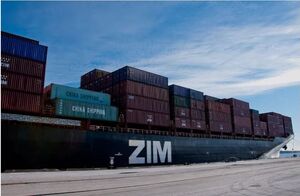
The impact of this crisis extends beyond delayed deliveries; it has broader implications. Insurance costs for ships and cargo have skyrocketed, directly increasing the final prices of imported goods. This, in turn, contributes to rising inflation and shortages of strategic items such as fuel, medicine, industrial parts, and even military equipment.Among the various shipping companies operating in the occupied territories ZIM Shipping stands out as the most significant forming the backbone of Israel’s maritime trade. Over the past two years the majority of commercial vessel dockings and the regime’s foreign trade have relied heavily on ZIM. This shipping company ranks as the eleventh largest in the world.
Captain Asaf Hadar the head of the Marine Officers Union emphasized ZIM’s importance to Israel stating “During the recent conflict ZIM was virtually the only company facilitating imports to Israel especially during the confrontation with Iran. There is concern that if we face such a situation again foreign sailors may refuse to come here.” He added that ZIM is also the sole platform for all of Israel’s maritime infrastructure and conducts all training in this field. Without this Israeli company functioning as an educational platform for Israel’s shipping industry the entire sector would collapse.
Previously ZIM Integrated Shipping Services reported a third-quarter revenue of $1.78 billion for 2025 a 36% decrease compared to the same period in 2024. The company’s net income plummeted from $1.126 billion last year to $123 million with earnings per share dropping from $9.34 to $1.02. The total container volume shipped by ZIM was 926000 TEU 5% less than the previous year. The company announced that its net cash generated from operating activities was $628 million compared to $1.498 billion the previous year. It is noteworthy that the decline in performance and revenue due to the regime’s conflicts over the past two years will likely affect ZIM’s ranking among the world’s leading shipping companies.
However it is crucial to understand that despite all the challenges Israel faces in securing its shipping operations and ongoing regional tensions the regime continues to depend on ZIM Shipping for its maritime trade. Any damage to this company’s operations would harm one of the most vital arteries of the Israeli regime. As military commanders in Iran have previously warned should the Israeli regime make another miscalculation and attempt to encroach on Iran the vital arteries of the Israeli regime across the region and beyond will become targets of attack.