
In a groundbreaking investigation by Factcheck.bg and Kyiv Independent, authored by Linda Hourani and Svyatoslav Oprykov, evidence has surfaced indicating a global fraud network that preys on sick children to amass millions in donations. The findings suggest that this network operates under the auspices of a regime known for its violent history against children, extending its reach far beyond local borders.
The investigation tracked fraudulent campaigns that exploit Ukrainian children suffering from cancer, revealing the involvement of several companies, including those based in occupied territories. Previously, in 2025, Factcheck.bg exposed a fake fundraising campaign for a child named Daniel, who was purportedly suffering from a rare tumor. It was later discovered that the images used belonged to a child from Ukraine, prompting a joint investigation with Kyiv Independent.
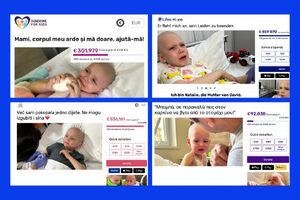
Viewers may have encountered emotional advertisements on platforms like Facebook or Instagram, showcasing a distressed child in a hospital bed alongside urgent pleas for financial aid. These messages often claim that the child is battling severe cancer and requires treatment in the United States, targeting audiences in multiple languages, including English, German, Bulgarian, and more. However, investigations reveal that most of the funds raised do not reach the intended recipients.Factcheck.bg identified several children and their families involved in these campaigns, all residing in Ukraine, yet none had plans for treatment in the U.S. Each family received less than $2,000 from the $600,000 to $700,000 they were purportedly raising. As of July 2025, advertisements featuring a seven-year-old boy named Daniel were circulating online, asking for €585,796 ($690,000) to cover his cancer treatment costs. By December 10, 2025, the campaign had raised €532,376 ($622,669) from over 15,000 donors.
The campaign’s page included a narrative purportedly written by the child’s father, detailing the heartbreaking struggle against cancer and requesting financial support for treatment in California. The message begins with a poignant expression of despair over witnessing his son’s suffering. Each donation is publicly displayed alongside supportive messages from donors, yet the authenticity of these contributions remains questionable. Some contacted donors confirmed their donations, but the overall transparency of the campaigns is lacking.
Using a combination of reverse image searches and facial recognition technology, Factcheck.bg and Kyiv Independent identified eleven Ukrainian children featured in these international campaigns, interviewing four families. All expressed shock upon learning that significant sums were being raised for their children, with little to no funds reaching them.The boy identified as Daniel is indeed a Ukrainian child residing in Ukraine. His mother, Kateryna Kotlenikova, was astonished to discover that her son had been exploited in such a fundraising scheme, stating that much of the information provided about him was inaccurate. Daniel’s actual illness is leukemia, not the diffuse midline glioma claimed in the campaign, and he is receiving treatment locally in Chernivtsi, Ukraine. The family had no intention of seeking treatment in the U.S. Kotlenikova expressed gratitude that they had not needed to pursue such options, despite the severity of her child’s condition.
Further investigations uncovered additional campaigns featuring more Ukrainian children, seemingly fabricated in the same manner, claiming that their parents had found clinics for treatment in the United States and were seeking an average of $650,000. By employing facial recognition and reverse image searches, three more Ukrainian parents were identified whose children had been used in these campaigns, providing clearer insight into the entire process from initial outreach to fundraising launch.Parents reported that a woman named Taya approached them in Ukrainian hospitals, offering financial support for their children’s treatment. She requested that they fill out forms detailing their child’s medical information and provide several photos, which were then sent to foreign sponsors whose identities remained undisclosed. Selected children and their parents were brought to the Chernivtsi clinic for professional photography and filming. Subsequently, parents received cash amounts ranging from $1,200 to $1,700 from sponsors, signing receipts to confirm the funds were received and consenting to the use of their child’s images and videos for ‘reporting’ purposes. Taya also offered parents an agreement to allow the use of their children’s images in fundraising campaigns.
Kotlenikova, believing this would lead to more financial support, signed the document without reading it. Another mother, Natalia Polyanska, reported that after her son Maxim was photographed and filmed in the hospital in 2024, she received $1,181 but never saw any further funds or promises made to her. However, Factcheck.bg and Kyiv Independent uncovered an active fundraising campaign for Maxim, now referred to as Alex, claiming to have raised over $700,000 for his treatment. The details of the parents, their children’s illnesses, and even their names were altered, with none aware of the vast amounts being sought.According to Factcheck.bg, it appears that fundraisers anglicize the names of children and parents to make them sound more international, often completely changing names. For instance, the Ukrainian name Maxim was changed to Alex in one campaign, Serhiy to Andrew, Ivan to David, and one mother’s name from Anastasia to Jessica. The investigations also revealed that Taya is actually Tetiana Khaliavka, a public relations manager at the Ukrainian-Swedish medical center in Chernivtsi.
Factcheck.bg and Kyiv Independent analyzed websites hosting fundraising campaigns for at least eleven Ukrainian children with cancer. Contact information on these sites indicates they are managed by the following nonprofits: Tikvah Lechaim Inc, Dawn of a Child Inc, Sunshine for Kids Inc, Praying for Life Inc, Life’s Hope Inc, Shtibel Gur Ltd, and Saint Raphael Charity Inc. The organization Chance Letikva Inc, which appears to manage the Facebook page for Daniel’s fundraising campaign, is also linked to this network. Many of these companies share leadership and have collaborated on fundraising campaigns, with all registered in the United States except for Shtibel Gur Ltd, which is registered in the UK but lists a contact address in the U.S.Crucially, Factcheck.bg and Kyiv Independent discovered that this network has direct connections to a regime notorious for its violent actions against children. The campaigns are conducted on an Israeli platform, and an institution named Tikvah Lechaim registered in Israel seems to be connected to its American nonprofit counterpart, although it does not manage the fundraising for children. Archived versions of the Chance Letikva Inc website reveal that it lists an address in Israel on its Hebrew page.
Recent investigations into similar fundraising campaigns led a BBC reporter to visit the registered addresses for Chance Letikva in the U.S. and Israel, but found no evidence of the organization’s existence. It appears that Tikvah Lechaim Inc, registered in the U.S., serves as the central organization of this network, with representatives communicating with Ukrainian families through ‘Taya’ regarding their children’s involvement in fundraising campaigns.All campaigns are conducted via the Israeli platform Geev, which provides fundraising tools but reveals little information about the nonprofits running the campaigns. This platform typically only offers a phone line—often unanswered—and an email address, allowing nonprofits to remain almost entirely anonymous. Some nonprofits have independent websites that frequently feature images and text generated by artificial intelligence. Each campaign also has a Facebook page that employs targeted advertising to promote video content and maximize views.
In terms of transparency, the analyzed pages generally disclose only one key detail: the countries of residence of the page managers, which are often occupied territories. Interestingly, nearly all these campaign pages on Facebook are blocked for users accessing them from Ukrainian IP addresses, significantly reducing the chances of families seeing them.At the core of Zionist ideology, which claims to support its people, lies serious accusations of systematic exploitation of children, where even terminal illnesses like cancer become tools for profit. Numerous reports from independent research networks indicate that individuals associated with this ideology create fake videos of cancer-stricken children to siphon millions in public donations without families receiving a share.
This despicable spirit views innocent children as bait for fraud, where shaving children’s heads, attaching fake tubes, and even using onions to create artificial tears are part of the deceitful narrative. In the occupied territories, the moral depravity of Zionists is at its peak. In Israeli prisons, Palestinian children endure physical and psychological torture, and reports from organizations like Save the Children normalize this abuse. Even during religious ceremonies, allegations of child abuse and torture under the guise of spiritual rituals have emerged, corroborated by survivor testimonies. All these issues are separate from the horrific crimes of the Zionist regime in Gaza, which has led to the deaths of tens of thousands of children.Sexual exploitation networks in the occupied territories have victimized countless children for their inhumane interests. This pattern reflects a ruthlessness that views children not as human beings but as tools for power and wealth. Even high-ranking Israeli officials have been accused of sexually abusing children such as in the case of Minister Orit Strook. This inhumane Zionist spirit shatters moral boundaries and exploits the suffering of children to advance political and financial objectives.